


Page 14 - www.hawaiibevguide.com
P. 14
SOUTHERN GLAZER’S AT ONE
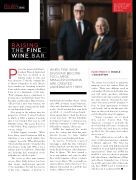
Steve Slater, EVP, General Manager, Wine and Mel Dick, SVP, President, Wine Division.
RAISING
THE FINE WINE BAR
Prior to the merger with Glazer’s, WHEN FINE WINE
Southern Wine & Spirits had long been recognized as an industry leader in wine and
wine education: Today the company has 15 Master Sommeliers on staff. Glazer’s legacy markets are bene ting from this focus, and the entire company is doubling down on its commitment to  ne wine. “Both companies share a commitment to growing wine,” says Mel Dick, Senior Vice President and President, Wine Division. “Glazer’s had a great wine business, but they want to make it bigger and we think we can help them do that.”
Few people in the industry have the perspective of Dick: “I joined Southern in March of 1969, a number of months after it was founded. That year we sold $890,000 of wine. This year we’ll do close to $6.6 billion. Wine represents 50% of our case volume.”
It didn’t happen overnight. “When Steve Slater joined Southern in 1989 in California, it was a much smaller wine company,” he recalls. “When Mel and the other leadership wanted to strengthen the wine business in the early 1990s, it was a turning point in California. Ownership and leadership had tremendous vision with what we could do in wine.”
The secret to their wine business success, Slater  rmly believes, has been their unique, multi-pronged approach to the marketplace through the creation of  ne wine companies or divisions to
INVESTMENT IN PEOPLE & EDUCATION
The merger has resulted in manpower ramp-ups across the country, Slater de- scribes: “There were different needs in each market: Florida needed Italian wine and craft spirits specialists, California wanted more sales reps as well as a smaller  ne wine division.” National Accounts teams were given portfolio managers to focus on chain opportunities for larger- scale brands; and on the  ne wine side, there are three new directors of strategy, each looking after about 20 suppliers.
“Young consumers are so much more curious,” observes Dick. “The American consumer is probably the most knowledgeable wine consumer in the world today. And they are trading up: The $15 to $25 range, that’s where the action is.”
That sophistication—as well as the savvy of today’s beverage buyer—demands a different approach. “The buyer has changed; to speak with highly-educated sommeliers we need highly-polished sales representatives,” Slater says. SGWS has installed a rigorous education program, led by Eric Hemer, a dual Master of Wine and a Master Sommelier (one of four in the world), and today 3,800 of their sales reps have WSET Level 2 Certi cation, with the goal of reaching 10,000. ■
DIVISIONS BECOME TOO LARGE, SMALLER DIVISIONS ARE CREATED UNDERNEATH THEM.
handle high-end, small producers. “In the early 1990s, Southern created American, a  ne wine distributor in California,” he recalls. “And I watched their team build a portfolio of coveted boutique brands.” Vassar tapped Slater to head the division several years later. “Moving Schieffelin & Somerset’s business to American was really the beginning of what became a $300 million company,” Slater says.
SGWS has employed this model across the country, and when  ne wine divisions become too large, smaller divisions are created underneath them.
In Seattle, Southern acquired Cavatappi, a small  ne wine wholesaler and has launched a new  ne wine division for the Paci c Northwest, called American Wine & Spirits. “We have learned a lot in new markets, and today we allow these small companies’ cultures to remain intact,” notes Slater. “We occasionally use separate delivery trucks; there has to be a different look and feel for a portfolio that reaches a different customer.”


