


Page 137 - Webster's Speller
P. 137
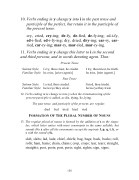
10. Verbs ending in y change y into i in the past tense and participle of the perfect, but retain it in the participle of the present tense.
cry, cried, cry-ing; de-fy, de-fied, de-fy-ing; ed-i-fy, ed-i-fied; ed-i-fy-ing; dry, dried, dry-ing; car-ry, car- ried, car-ry-ing; mar-ry, mar-ried, mar-ry-ing.
11. Verbs ending in y change this letter to i in the second and third persons, and in words denoting agent. Thus:
Solemn Style: Familiar Style:
Solemn Style: Familiar Style:
Present Tense
I cry, thou criest, he criedst. he cries, [crier (agent).]
Past Tense
I cried, thou criedsd. he/we/ye/they cried.
I try, thou triest, he trieth. he tries, [trier (agent).]
I tried, thou triedst. he/we/ye/they tried.
12. Verbs ending in ie change ie into y when the termination ing of the present participle is added, as die, dying, lie, lying.
The past tense, and participle of the present, are regular.
died lied tried hied vied
FORMATION OF THE PLURAL NUMBER OF NOUNS
13. The regular plural of nouns is formed by the addition of s to the singu- lar, which letter unites with most consonants in the same syllable, but sounds like z after all the consonants except the aspirate f, p, q, t, k, or c with the sound of k.
slab, slabs; lad, lads; chief, chiefs; bag, bags; back, backs; roll, rolls; ham, hams; chain, chains; crop, crops; tear, tears; straight, straights; post, posts; port, ports; sight, sights; sign, signs.
136


