


Page 134 - Demo
P. 134
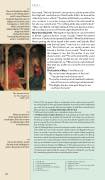
1:26 The visit of Gabriel to Mary is known as the “Annunciation” and it is one of the most frequently depicted scenes in religious art. In the fresco by Fra Angelico (c. 1400-1455), Mary is at prayer when Gabriel appears. The mighty angel bows before the humble maiden, honoring the great mystery which is to unfold in her.
The Annunciation, by Fra Angelico, 1400-1455
1:34 Mary asks questions of the angel about what is to take place, then she consents to what God asks of her in total freedom.
1:44 Even in his mother’s womb, the infant John the Baptist is alert to the presence of Christ.
122
LUKE
her in reply, “The holy Spirit will come upon you, and the power of the Most High will overshadow you. Therefore the child to be born will be called holy, the Son of God.q 36And behold, Elizabeth, your relative, has also conceived* a son in her old age, and this is the sixth month for her who was called barren; 37for nothing will be impossible for God.”r 38Mary said, “Behold, I am the handmaid of the Lord. May it be done to me according to your word.”Then the angel departed from her.
Mary Visits Elizabeth. 39During those days Mary set out and traveled to the hill country in haste to a town of Judah, 40where she entered the house of Zechariah and greeted Elizabeth. 41When Elizabeth heard Mary’s greeting, the infant leaped in her womb, and Elizabeth, filled
with the holy Spirit,s 42cried out in a loud voice and said, “Most blessed are you among women, and blessed is the fruit of your womb.t 43And how does this happen to me, that the mother of my Lord* should come to me? 44For at the moment the sound of your greeting reached my ears, the infant in my womb leaped for joy. 45Blessed are you who believed* that what was spoken to you by the Lord would be fulfilled.”u
The Canticle of Mary. 46v And Mary said:*
“My soul proclaims the greatness of the Lord;w
47my spirit rejoices in God my savior.x
48For he has looked upon his handmaid’s lowliness; behold, from now on will all ages call me blessed.y
49The Mighty One has done great things for me, and holy is his name.z
* [1:36–37] The sign given to Mary in con rmation of the angel’s announcement to her is the pregnancy of her aged relative Elizabeth. If a woman past the childbearing age could become pregnant, why, the angel implies, should there be doubt about Mary’s pregnancy, for nothing will be impossible for God.
* [1:43] Even before his birth, Jesus is identi ed in Luke as the Lord.
* [1:45] Blessed are you who believed: Luke portrays Mary as a believer whose faith stands in contrast to the disbelief of Zechariah (Lk 1:20). Mary’s role as believer in the infancy narrative should be seen in connection with the explicit mention of her presence among “those who believed” after the resurrection at the beginning of the
Acts of the Apostles (Acts 1:14).
* [1:46–55] Although Mary is praised for being the mother of the Lord and because
of her belief, she reacts as the servant in a psalm of praise, the Magni cat. Because there is no speci c connection of the canticle to the context of Mary’s pregnancy and her visit to Elizabeth, the Magni cat (with the possible exception of v 48) may have been a Jewish Christian hymn that Luke found appropriate at this point in his story. Even if not composed by Luke, it ts in well with themes found elsewhere in Luke: joy and exultation in the Lord; the lowly being singled out for God’s favor; the reversal of human fortunes; the ful llment of Old Testament promises. The loose connection between the hymn and the context is further seen in the fact that a few Old Latin manuscripts identify the speaker of the hymn as Elizabeth, even though the overwhelming textual evidence makes Mary the speaker.
q. [1:35] Mt 1:20.
r. [1:37] Gn 18:14; Jer 32:27; Mt 19:26.
s. [1:41] 1:15; Gn 25:22 LXX.
t. [1:42] 11:27–28; Jgs 5:24; Jdt 13:18; Dt 28:4. u. [1:45] 1:20.
v. [1:46–55] 1 Sm 2:1–10.
w. [1:46] Ps 35:9; Is 61:10; Heb 3:18.
x. [1:47] Ti 3:4; Jude 25.
y. [1:48] 11:27; 1 Sm 1:11; 2 Sm 16:12; 2 Kgs 14:26;
Ps 113:7.
z. [1:49] Dt 10:21; Ps 71:19; 111:9; 126:2–3.


