


Page 16 - Demo
P. 16
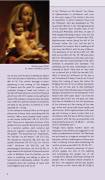
Madonna and Child. St. James Cathedral, Seattle
his victory over the devil’s attempt to deflect him from the way of obedience to the Father (Mt 4:1–11). The central message of Jesus’ preaching is the coming of the kingdom of heaven and the need for repentance, a complete change of heart and conduct, on the part of those who are to receive this great gift of God (Mt 4:17). Galilee is the setting for most of his ministry; he leaves there for Judea only in Mt 19:1, and his ministry in Jerusalem, the goal of his journey, is limited to a few days (Mt 21:1–25:46).
In this extensive material there are five great discourses of Jesus, each concluding with the formula “When Jesus finished these words” or one closely similar (Mt 7:28; 11:1; 13:53; 19:1; 26:1). These are an important structure of the gospel. In every case the discourse is preceded by a narrative section, each narrative and discourse together constituting a “book” of the gospel. The discourses are, respectively, the “Sermon on the Mount” (Mt 5:3–7:27), the missionary discourse (Mt 10:5–42), the parable discourse (Mt 13:3–52), the “church order” discourse (Mt 18:3–35), and the eschatological discourse (Mt 24:4–25:46). In large measure the material of these discourses came to Matthew from his tradition, but his work in modifying and adding to what he had received is abundantly evident. No other evangelist gives the teaching of Jesus with such elegance and order as he.
In the “Sermon on the Mount” the theme of righteousness is prominent, and even at this early stage of the ministry the note of opposition is struck between Jesus and the Pharisees, who are designated as “the hypocrites” (Mt 6:2, 5, 16). The righteousness of his disciples must surpass that of the scribes and Pharisees; otherwise, in spite of their alleged following of Jesus, they will not enter into the kingdom of heaven (Mt 5:20). Righteousness means doing the will of the heavenly Father (Mt 7:21), and his will is proclaimed in a manner that is startling to all who have identified it with the law of Moses. The antitheses of the Sermon (Mt 5:21–48) both accept (Mt 5:21–30, 43–48) and reject (Mt 5:31–42) elements of that law, and in the former case the understanding of the law’s demands is deepened and extended. The antitheses are the best commentary on the meaning of Jesus’ claim that he has come not to abolish but to fulfill the law (Mt 5:17). What is meant by fulfillment of the law is not the demand to keep it exactly as it stood before the coming of Jesus, but rather his bringing the law to be a lasting expression of the will of God, and in that fulfillment there is much that will pass away. Should this appear contradictory to his saying that “until heaven and earth pass away” not even the smallest part of the law will pass (Mt 5:18), that time of fulfillment is not the dissolution of the universe but the coming of the new age, which will occur with Jesus’ death and resurrection. While righteousness in the new age will continue to mean conduct that is in accordance with the law, it will be conduct in accordance with the law as expounded and interpreted by Jesus (cf. Mt 28:20, “. . .all that I have commanded you”).
Though Jesus speaks harshly about the Pharisees in the Sermon, his judgment is not solely a condemnation of them. The Pharisees are portrayed as a negative example for his disciples, and his condemnation of those who claim to belong to him while disobeying his word is no less severe (Mt 7:21–23, 26–27). In Mt 4:23 a summary statement of Jesus’ activity speaks not only of his teaching and proclaiming the gospel but of his “curing every disease and illness among the people”; this is repeated almost verbatim in Mt 9:35. The narrative section that follows the Sermon on the Mount (Mt 8:1–9:38) is
4


