


Page 274 - Demo
P. 274
THE ACTS OF THE APOSTLES
that, instead of opening the gate, she ran in and announced that Peter was standing at the gate. 15They told her, “You are out of your mind,” but she insisted that it was so. But they kept saying, “It is his angel.” 16But Peter continued to knock, and when they opened it, they saw him and were astounded. 17He motioned to them with his hand to be quiet and explained [to them] how the Lord had led him out of the prison, and said, “Report this to James* and the brothers.” Then he left and went to another place. 18At daybreak there was no small commotion among the soldiers over what had become of Peter.c 19Herod, after instituting a search but not nding him, ordered the guards tried and executed. Then he left Judea to spend some time in Caesarea.
Herod’s Death. 20* He had long been very angry with the people of Tyre and Sidon, who now came to him in a body. After winning over Blastus, the king’s chamberlain, they sued for peace because their country was supplied with food from the king’s territory. 21On an appointed day, Herod, attired in royal robes, [and] seated on the rostrum, addressed them publicly. 22The assembled crowd cried out, “This is the voice of a god, not of a man.” 23At once the angel of the Lord struck him down because he did not ascribe the honor to God, and he was eaten by worms and breathed his last. 24But the word of God continued to spread and grow.d
Mission of Barnabas and Saul. 25After Barnabas and Saul completed their relief mission, they returned to Jerusalem,* taking with them John, who is called Mark.e
* [12:17] To James: this James is not the son of Zebedee mentioned in Acts 12:2, but is James, the “brother of the Lord” (Gal 1:19), who in Acts 15; 21 is presented as leader of the Jerusalem Christian community. He left and went to another place: the conjecture that Peter left for Rome at this time has nothing to recommend it. His chief responsibility was still the leadership of the Jewish Christian community in Palestine (see Gal 2:7). The concept of the great missionary e ort of the church was yet to come (see Acts 13:1–3).
* [12:20–23] Josephus gives a similar account of Herod’s death that occurred in A.D. 44. Early Christian tradition considered the manner of it to be a divine punishment upon his evil life. See 2 Kgs 19:35 for the gure of the angel of the Lord in such a context.
* [12:25] They returned to Jerusalem: many manuscripts read “from Jerusalem,” since Acts 11:30 implies that Paul and Barnabas are already in Jerusalem. This present verse could refer to a return visit or subsequent relief mission.
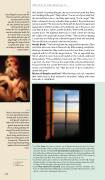
12:2 Herod begins to persecute the church in earnest, and James becomes the rst of the apostles to be martyred. In art, two symbols are used to distinguish the apostle James: the cross shaped like a sword, recalling his death “by the sword” (Acts 12:2), and the scallop shell, the sign of pilgrimage to the shrine of Santiago de Compostela in northwestern Spain—site, according to tradition, of the tomb of James.
12:6 Peter is obviously considered to be an important prisoner, bound with “double chains,” with guards sleeping on either side of him while other guards keep watch outside the door. But guided by the angel, Peter walks forth from the prison. The miracle is God’s doing, but God acts in response to the prayers of the community: “Prayer by the church was fervently being made to God on his behalf” (12:5).
c. [12:18] 5:22–24.
d. [12:24] 6:7.
e. [12:25] 11:29–30.
262


