


Page 307 - Demo
P. 307
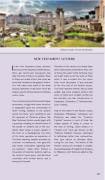
Roman Forum, Fotolia ©Fabiomax
In the New Testament canon, between the Acts of the Apostles and Revelation, there are twenty-one documents that
take the form of letters or epistles. Most of these are actual letters, but some are more like treatises in the guise of letters. In a few cases even some of the more obvious elements of the letter form are absent; see the Introductions to Hebrews and to 1 John.
The virtually standard form found in these documents, though with some variation, is dependent upon the conventions of letter writing common in the ancient world, but these were modified to suit the purposes of Christian writers. The New Testament letters usually begin with a greeting including an identification of the sender or senders and of the reci- pients. Next comes a prayer, usually in the form of a thanksgiving. The body of the letter provides an exposition of Christian teaching, usually provoked by concrete circumstances, and generally also draws conclusions regarding ethi- cal behavior. There often follows a discussion of practical matters, such as the writer’s travel plans, and the letter concludes with further advice and a formula of farewell.
Fourteen of the twenty-one letters have been traditionally attributed to Paul. One of these, the Letter to the Hebrews, does not itself claim to be the work of Paul; when it was accepted into the canon after much discussion, it was attached at the very end of the Pauline corpus. The other thirteen identify Paul as their author, but most scholars believe that some of them were actually written by his disciples; see the Introductions to Ephesians, Colossians, 2 Thessalonians, and 1 Timothy.
Four of the letters in the Pauline corpus (Ephesians, Philippians, Colossians, and Philemon) are called the “Captivity Epistles” because in each of them the author speaks of being in prison at the time of writing. Three others (1–2 Timothy and Titus) are known as the “Pastoral Epistles” because, addressed to individuals rather than communities, they give advice to disciples about caring for the flock. The letters of the Pauline corpus are arranged in roughly descending order of length from Romans to Philemon, with Hebrews added at the end.
NEW TESTAMENT LETTERS
295


