


Page 2 - Demo
P. 2
As part of the updated Enterprise Strategy, there is increased focus on collaborating externally.
This includes crowdsourcing, or seeking solutions to speci c challenges from problem solvers outside
the company.
AN INDUSTRY TREND
Crowdsourcing is a growing
practice in the world of innovation. Apple, for example, has turned to outside developers to create apps and podcasts. General Mills has crowdsourced ingredient suggestions for its foods. Anheuser-Busch sought customer input to develop a new craft beer brand. And biologists at the University of Washington partnered with external contributors to map the structure of an AIDS-related virus.
Companies that don’t crowdsource risk falling behind. As retired P&G executive Nabil Sakkab once said, “ There are 1.5 million people in the world who know about my business. I want them on my team.”
To use an analogy: Imagine that you’re a doctor trying to treat a patient with particularly puzzling symptoms. You— and the other physicians within your practice—are at a loss for how to help. Should you continue relying only on your own limited expertise and taking time away from other patients to solve this one case? Or would you have more
success consulting experts elsewhere who might already have a solution? Tapping into a broader pool of experts seems like the clear choice—both to  nd the right solution and to make the most effective use of your time.
PROTECTING INTELLECTUAL PROPERTY
At Gore, crowdsourcing is in the early stages. Around 40 Associates from across divisions attended a workshop on the topic at Barksdale last fall. The daylong event offered an introduction to one of Gore’s crowdsourcing
partners, InnoCentive, and their process for sharing challenges and seeking solutions. “We are getting the word out about crowdsourcing and getting Associates more comfortable with exploring it,” Greg notes.
This focus on crowdsourcing doesn’t mean external innovators will create Gore’s next breakthrough products
or experiment with Gore’s core technologies. Instead, Gore can use crowdsourcing anonymously to tap into solutions outside the company that don’t rely on our intellectual property. This, in turn, allows Associates to channel their time and energy in areas where Gore has unique expertise.
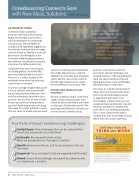
Five Traits of Good Crowdsourcing Challenges:
1 Limited Scope: Pose challenges that can be solved within months by one person or a small team.
2 Actionable: Be prepared to take action.
What are you going to do if you get a solution?
3 Speci c: Narrow your focus; don’t pose questions that are too broad.
4
5
Supported: Focus on projects that are supported and funded.
Owned: Ensure that challenges are owned by someone who can implement a solution.
shifting how we think and work
I will jump into action and solve this problem within my team.
I will tap into internal and external resources to see who has already solved this.
To position Gore for long-term success, Associates are shifting how they think and work. Crowdsourcing is one example of better tapping into solutions that already exist. When you or others jump into action, pause and ask: “Has someone already solved this?”
2 GORE LATTICE . APRIL 2016
Crowdsourcing Connects Gore
with New Ideas, Solutions
continued from cover
›››


