


Page 31 - Advertising Annual 55
P. 31
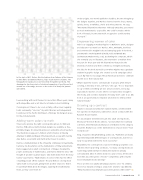
                 In the style of M.C. Escher, this bird pattern from Patterns of the Universe, by Alex Bellos and Edmund Harriss, helps teach math to students. The tiling pattern repeats pieces (or tiles) that fit together perfectly. This drawing also has four points of rotational symmetry—if you flip one bird around one of its wings, its torso or the crest of its head, the pattern will still fit.
been working with such themes for more than fifteen years, many with HarperOne and as art director at Amber Lotus Publishing.
Coloring doesn’t have to be a solo activity, either. Hess regularly holds community “color-ins” at public libraries and independent bookstores in the Pacific Northwest, offering a fun hangout space for like-minded adults.
Adding warm colors to math
Classrooms provide the right coloring atmosphere for Edmund Harriss, PhD, whose math-minded designs are available as free, printable images for university professors and public-school teachers. The illustrations appear in Patterns of the Universe: A Coloring Adventure in Math and Beauty (The Experiment, 2015), with text by Alex Bellos, a journalist and math writer based in London.
Harriss, a mathematician at the University of Arkansas in Fayetteville, had done his dissertation on the mathematics of tiling and patterns. Bellos suggested an adult coloring book of images showing the power and beauty of mathematics, and Harriss liked the idea. “We thought it would be a great way to take math down from the ivory tower,” says Harriss. “Mathematics in school often has the effect of putting people off the subject.” His and Bellos’s coloring book “gets math out to people, giving them another chance to find it.
I hope they’ll think about the images, exploring the mathematics there, as they color them in.”
Under a tight, one-month publisher deadline, the two thought up the designs together, and Harriss churned out the loops, waves, spirals, knots, snowflakes, shells and other patterns. He says, “We wanted illustrations that were obviously attractive, yet covered as much mathematics as possible. We could’ve made a whole book of fractals, but we wanted it to appeal to a wide variety
of people.”
Empowering women of color
Hair is as engaging to Andrea Pippins—a Baltimore artist, designer and educator—as math is to Harriss. Afros, Mohawks, beehives and cornrows join straight locks and sweeping updos in her book, I Love My Hair: A Coloring Book of Braids, Coils and Doodle Dos (Schwartz & Wade Books, 2015). Eschewing the computer, which she normally uses to illustrate, she returned to a medium from her past for these pen-and-ink illustrations that praise the diversity of women and their confidence, strength and beauty.
The idea for the book started in 2008 when Pippins was a graduate student in graphic design. She created a social campaign called
I Love My Hair to encourage African American women to celebrate and let loose their natural hair.
“What I want the book to communicate to people, while they’re coloring, is the idea of love, self-love,” she says. “It’s so important to say or think something we love about ourselves, every day, especially for women of color. We’re not represented enough in the media, and society’s standards of beauty don’t cater to us. My book is an opportunity to empower all women to embrace their natural beauty.”
Drawing up a contract
Pippins’s unusual and attractive subject matter, combined with her expertise in illustration, nabbed her a book contract with the Random House imprint.
For any designer determined to get into adult coloring books, Mockus at Chronicle Books advises, “Look at what else is already out there, then think about what your contribution to the category would be. Really focus on the distinctiveness of your vision—how it stands out.”
King, of Laurence King Publishing, points out, “Publishers are busily experimenting with different types of coloring books, but it’s too early to say which will be the most successful.”
Meanwhile, the coloring-book craze isn’t letting up anytime soon. “On the other hand,” King continues, “so many coloring books are now being published that it is likely the market is already oversaturated. Once it settles down in a year or two, it’ll become more like any other genre of books—competitive, with only the most remarkable books winning.”
Those are the ones adults will always want to color. “As children, most of us enjoyed coloring as a way to be creative,” says Marotta. “Why should we stop simply because we’ve grown a little older?” ca
Communication Arts | commarts.com 31


