


Page 46 - Advertising Annual 55
P. 46
                CONTRAPUNTO BBDO
Reflecting its passion for social good, Contrapunto BBDO has formed strong relationships with nongovernmental organizations, conceiving big ideas that either raise money and awareness for important causes or advocate to alter policy. For Amnesty International, the agency’s empathy is apparent in its 2015 ad, “Terrorists.” The
ad initially appears to be about terrorism, opening on two masked men who list their demands—“the immediate release of our own from prison; the persecution must be stopped.” When the men hold hands and unmask themselves, viewers realize they aren’t terrorists. The self-described “criminals” who are “endangering stability” are a gay couple. Finally, overlay text reveals, “In four of every ten countries, homosexuality is punishable with a prison sentence or even the death penalty.”
It’s an efficient approach, playing off our prejudices to increase impact. Coral says, “We’ve learned a lot about how to create a high impact with a low budget. Sometimes you have to move the people—and sometimes you can make it fun. It comes back to the idea that there are two ways to communicate: to surprise or emotionally connect.”
The shock-tactic method is apparent in Contrapunto BBDO’s attention-grabbing prints for the World Wildlife Fund. Harnessing the power of beauty, the visually arresting images raise awareness about the extinction of the most unique and protected species on the planet, showing animals turning to dust in an explicit way.
For Amnesty International, the work is more rational and persuasive—even, at times, amusing. For its Putin digital
ad, Contrapunto BBDO uses the Amnesty logo as if it were a fly buzzing around the nose of certain world leaders and making them look cross-eyed. It deftly mixes comedy with heavy-hitting and thought-provoking concepts.
In 2002, the agency opened its office in Barcelona, with Coral at the helm. He had previously held the position of business director of Bates Europe and left to head Contrapunto BBDO’s new Barcelona office. He and six others got the new location going. It grew quickly, and in 2008, it merged with a digital agency headed by Joaquim Calaf, who is now the general manager of the Barcelona office. “The merger was important for the evolution of the agency,” says Coral, “and for our relationship between the two cities.”
Calaf adds, “The environment in Barcelona is very different from that of Madrid. Whereas Madrid is the capital city with a liberal identity formed from la movida, in Barcelona, the personality is more structured. Also, the digital background is stronger in Barcelona, and this has its influence on the work, too. You can appreciate the difference in our copywriting most of all. Whereas both cities pursue an emotional connection, in Madrid, there is a very natural way of talking that mimics the Spanish sense of humor. In Barcelona, there is always a trace of irony, and we are less subtle in our approach.”
Today, more than half of Contrapunto BBDO’s work is digital— a trend that is set to grow. But for the agency, content is the most important thing. To put it simply: idea first, medium second. “We try to be clear in not confusing tools and goals,” says Jorge. “In some cases, technology is attractive. It’s fancy, it’s nice, it’s new—but a brand cannot survive with fake media. It still has to create a conversation. If the work is good, then the channels we use are less important.”
In approaching a project by defining the challenge, Contrapunto BBDO’s aim has been to understand the context and come up with an idea that is relevant—not in terms of consumers, but in terms of human beings. Four decades on, these values remain the same. This is helped in part by promoting the values from within—the mentorship aspect of the agency is strong. But it also works hard to understand what people are feeling and thinking about, perhaps now more so than ever.
 46
Illustration Annual 2016
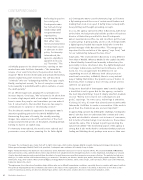
This page: The Contrapunto BBDO team, from left to right: Carlos Jorge, chief creative manager, Madrid; Joaquim Calaf, general manager, Barcelona; Paco Ribera, general manager, Madrid; David Coral, president, Contrapunto BBDO and BBDO & Proximity Group in Spain.
Right: “Fundación Reina Sofía wanted to raise awareness about Alzheimer’s disease to boost its research efforts. We created the Bank of Memories (bancoderecuerdos.com), a website where visitors deposit their most valuable memories through text, photo or video. Big brands, including Coca-Cola and Google, deposited memories and promoted them. Residents of a small town even saved their memories as a group collection. The website has had more than 750,000 visits and has collected more than 35,500 memories.” Eva Janire, art director; Xisela Lopez, writer; Javier Luján, graphic designer; Félix Del Valle/Carlos Jorge, chief creative officers; Patricia Miguel, strategy; Marta Peréz Antelo, editor; Gema Crespo, senior producer; Arturo Luis Coello Villanueva, Fundación Reina Sofía, client.
“Through soccer, the FC Barcelona Foundation helps children who are in difficult humanitarian conditions, especially those in countries with armed conflicts. This print ad helped publicize these initiatives and reinforce the values of the organization. As stated on its shield, FC Barcelona is more than a club.” Carlos De Javier/Lucas Jatoba, art directors; Emma Piquer, writer; Carlos De Javier, creative director; FC Barcelona Foundation, client.


