


Page 21 - Monocle Quarterly Journal Vol 3 Issue 2 Spring
P. 21
THE HISTORY AND SCIENCE OF ARTIFICIAL INTELLIGENCE
  up the system. The first layer receives the external input, whilst the last layer delivers the prediction – in this case, a number from zero to nine. The set of layers wedged in between the first and last layers is where the calibration and filtering process happen, and these layers are often called the hidden layers. The activation of various neurons in these hidden layers will determine the final prediction in the last layer of neurons.
The example of image recognition for handwritten text is fairly complex, since the data being fed into the system is not in a neat numerical format – yet this is where neural networks have an advantage over other machine
a neuron in the first layer of the network. The first layer would then be 784 neurons long, each capturing the grayscale value of their corresponding pixel, often as a value from zero to one, where zero is pure white and one is pure black, for example.
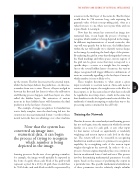
Now that the system has converted an image into numerical data, it can begin the process of trying to recognise which number is being depicted in the image. In different implementations of neural networks, this step will vary greatly, but in this case, the hidden layers within the net will usually try to identify various shapes in the image by analysing the hard edges of the picture. By analysing the grid in a way that distinguishes between the black markings and white spaces, various regions of the grid can be given scores that may correspond to a specific shape – a curve or a straight line, for example. Across the several hidden layers of neurons, the various shapes recognised will trigger different combinations of neurons, eventually signalling to the last layer of neurons which number it is most likely to be.
These weights determine to what extent a given input is relevant to a certain neuron. Since each neuron receives multiple inputs, the weights serve as the filter for these inputs, to let the neuron know what factors should be regarded as most important – much in the same way that dendrites in the biological neural network filter the multitude of stimuli attempting to make their way to the processing centre contained in the cell body.
Training the Network
Thus far, however, the actual analysis and learning process has not yet begun, since the manner in which the system decides on a score for each grid, or any other input for that matter, is based on equivalently or randomly weighting each neuron input at each level in the deep net. The system will not be successful in recognising handwritten numbers unless it optimises its recognition capability by re-weighting each of the neuron input weights throughout the network. In order to do so, a process of reverse engineering takes place on a continuous basis in an advanced form of trial and error. This process involves determining mathematical parameters for each input, based on the success of predicting the output in a particular run. The specific mathematical calculations of these parameters involve relatively simple calculus
 Now that the system has converted an image into
numerical data, it can begin the process of trying to recognise
which number is being depicted in the image.
learning processes. In the case of recognising a number, for example, the image would typically be inputted in the form of a grid, where each block of the grid would represent a pixel. In a 28 by 28 grid, there would then be 784 blocks, and each block would be represented by
19


