


Page 24 - Monocle Quarterly Journal Vol 3 Issue 2 Spring
P. 24
MONOCLE QUARTERLY JOURNAL | DEEP LEARNING
that IBM’s Deep Blue beat the world chess champion, Garry Kasparov, in a televised event that captured the imaginations of millions of onlookers worldwide. It was the first time that many people realised the potential of machines to mimic intelligence and this sparked mass interest in the field of artificial intelligence. The Deep Blue event, which attracted more than 70 million
very much unnoticed by the common user, as the AI is often hidden in technologies and software that we use every day, such as our laptops and smartphones, as well as within the apps and social media platforms that consume so much of our attention. We simply need to think of recent developments in facial recognition that allow us to unlock our phones, or that recognise and tag our friends in our uploaded pictures, and it becomes apparent that we unwittingly use deeply complex artificial intelligence technologies almost every day.
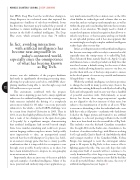
In fact, avoiding interaction with artificial intelligence has become near-impossible in today’s connected world, especially since the omnipotence of so-called Big Tech. These behemoth firms, namely Facebook, Apple, Google and Amazon, have so utterly pervaded our daily lives that trust has become a default setting for the users of their services. And in allowing them free access to our lives, we provide them with one of the key components to success in the development of even more powerful and intrusive AI capabilities – our data.
Whilst the artificial intelligence revolution promises to change the world in many positive ways, there is the risk that this exciting field may be wholly absorbed by Big Tech and subsequently used in any way that a handful of powerful executives wish. Unfortunately, as recent history has shown, these mega-corporations’ agendas are not aligned to the best interests of their users, but rather to the maximisation of profits at all costs. What is even more disturbing is that the individuals who once held the torch as AI purists – academics who had always looked at the bigger picture and wanted to use artificial intelligence to solve real pressing problems in the world – have now been lured into the research labs of Big Tech. This includes even the die-hard Canadian researchers who brought AI from the backrooms of academia to the forefront of modern technology, with Hinton working for Google and LeCun for Facebook. And whilst the third and youngest member of the Canadian Mafia, Yoshua Bengio, has managed to resist the extravagant salaries given to AI experts by Big Tech, it does seem as if he is fighting against the tide. One can only hope that such an important field of research will not continue to be overly dominated by a few large corporations, bringing to mind a Terminator-esque future controlled by the likes of an all-powerful Skynet. And in this sense, the story of artificial intelligence has just begun.
In fact, avoiding interaction with artificial intelligence has
become near-impossible in today’s connected world,
especially since the omnipotence of what has become known
as Big Tech.
viewers, was also indicative of the progress hardware had made in significantly shortening processing times, allowing for speeds never seen before, with IBM’s chess- playing machine being able to run through a reported 200 million moves per second.
This excitement, combined with the progress made in raw computing power, led to many significant milestones for artificial intelligence in the coming years. Such successes included the driving of a completely autonomous vehicle for 131 miles – on a route previously unknown to the vehicle – in the DARPA challenge, won by a team from Stanford University in 2005. Then in 2011, in another highly publicised event, IBM’s Watson beat a team of two champions at the quiz show game of Jeopardy! by a significant margin, demonstrating that artificial intelligence had moved beyond simple brute force number-crunching and could now process written language within complex contexts. And possibly most impressively to date, an unsupervised neural network beat the world champion Go player, Lee Sedol, in an ancient strategy game that has so many possible combinations that it is impossible for a computer to run through every possible board position, as in chess, but has to learn intuitively how to improve its own gameplay in an autonomous fashion.
Importantly, these are just some of the most publicly exposed examples of artificial intelligence. Many of the more practical and industry-important applications go
22


