


Page 28 - Monocle Quarterly Journal Vol 3 Issue 2 Spring
P. 28
MONOCLE QUARTERLY JOURNAL | DEEP LEARNING
  And because of this special place in Korean culture, those who excel at Go are generally regarded as some of the most intelligent individuals amongst their peers.
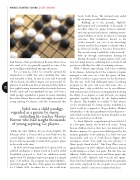
For a young Lee Sedol, Go instantly captured his imagination as wildly fun and something that came very naturally to him. At just 12 years and 4 months old, he became the fifth youngest ever professional Go player in South Korean history and enjoyed the thrill of thoroughly beating international professionals that were double, triple and even quadruple his age. Sedol was a child prodigy, regarded as a genius by many, including his teacher Master Kweon who had taught thousands of young aspiring Go players, and who commented that
Seoul, South Korea. The televised event ended up attracting over 200 million viewers.
Building up to the spectacle, AlphaGo had trained itself on hundreds of thousands of recorded online Go games between amateurs and semi-professional players, studying statisti- cal probabilities of moves in relation to winning outcomes. This foundation, known as the “policy network”, was one of two knowledge systems used by the program to identify what a good move looks like, to become a better player. The second system is called the “value network”, built up through reinforcement learning by playing thousands of games against itself, each
time becoming better at evaluating how a certain board position would affect the odds of a winning outcome.
With 9 March approaching, Sedol was confident in his chances, believing that if the computer program managed to take even one of the five games off him, he would consider it a great success for the developers. The fact was, Sedol had challenged many Go-playing programs in the past, and none had come close to defeating him – why would this one be any different? And in many ways, Sedol was not misguided in doubting the ability of a computer to reach the levels of complex gameplay capably displayed by the highest-ranked Go players. This handful of so-called “9 dan” players on the international Go rating system, including Lee Sedol, could be compared to Roger Federer, Michael Schumacher, or the chess grandmaster Garry Kasparov – each widely considered the best in their discipline at the time, or even the best of all time.
So, when AlphaGo comprehensively beat Sedol 4-1 in a five-game match, the world took notice. Young Korean children cried as their hero was defeated by a British computer, Go experts were flabbergasted by the intricate gameplay of the machine, Lee Sedol was near inconsolable, and one of South Korea’s biggest daily newspapers stated, “Last night was very gloomy [...] Many people drank alcohol.” Like Deep Blue’s victory against Kasparov in 1997, AlphaGo had beaten a human world champion at their own game. But this time was different. Unlike the controversy and blame games that resulted in 1997, AlphaGo had won fair and square. Even Sedol was humbled and impressed by the gameplay and tactics employed by the program in post-match interviews. And Go is far more complex than chess.
 Sedol was a child prodigy, regarded as a genius by many,
including his teacher Master Kweon who had taught thousands
of young aspiring Go players...
“unlike the other children, his eyes shone brightly.” By February 2016, a 33-year-old Lee Sedol had won the second highest number of international titles in Go history and was generally considered the greatest player in the world at the time.
In 2016, after being acquired by Google in 2014, an artificial intelligence company based in London called DeepMind proposed to Sedol an exhibition match against their Go playing computer program for a grand prize of $1 million. The program was called AlphaGo, and Sedol agreed. The first of five games was scheduled for 9 March 2016, broadcast live to the world from
26


