


Page 31 - Monocle Quarterly Journal Vol 3 Issue 2 Spring
P. 31
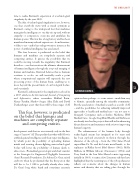
time to realise Kurzweil’s expectation of a technological singularity by the year 2045.
The idea of technological singularity is not, however, one that everybody views with as much optimism as Kurzweil, owing to the widespread fear that machines may gain the intelligence to one day rise up and, without empathy or compassion, overcome and annihilate the human species. This fear has a long history and has been manifested in many cultural expressions – from literature, to film, to art – and it has only grown more intense as the power of artificial intelligence has accelerated.
This fear, however, is predicated on the belief that humans and machines are completely separate and competing entities. It ignores the possibility that we could be moving towards the singularity that Kurzweil describes – one that envisions the ultimate advancement of human intelligence through the corporeal merging of human and machine. Kurzweil believes that as humans continue to evolve, we will inevitably reach a point where computational capacity will supersede the raw processing power of the human brain, enabling us to move beyond the present limits of our biological bodies, and our minds.
Kurzweil’s enthusiasm for the singularity is echoed in a 2017 article in An International Journal of Computing and Informatics, where researchers Mikhail Batin, Alexey Turchin, Markov Sergey, Alisa Zhila and David Denkenberger assert that there will be three stages of AI
RAYMOND KURZWEIL
opinions have perhaps – to some extent – made him easy to dismiss, especially among the scientific community. But the acceleration of medical research as a result of AI – and the possibilities for achieving radically improved approaches to health and medical care – are not easy to disregard. Companies such as Insilico Medicine, IBM Medical Sieve, Google DeepMind Health and Turbine.ai are already involved in projects that will aid in advancing disease detection and treatment, with a view to improving human longevity.
The enhancement of the human body through technological means has intrigued us for years and has been explored extensively in fiction through the character of the cyborg – from the 1962 James Bond supervillian Dr No and his bionic metal hands, to the replicants in Ridley Scott’s Blade Runner (1982), Molly Millions in William Gibson’s Neuromancer (1984), and Tony Stark in the Iron Man Marvel comics (appearing initially in 1963), to name a few. Literature scholars have highlighted that the recurring use of the cyborg character reflects our concerns about the changes in human nature and identity that are taking place through the
THE SINGULARITY
    This fear, however, is predicated on the belief that humans and machines are completely separate
and competing entities.
development, and that we are currently only in the first stage of “narrow” AI. They predict that what will follow is artificial general intelligence and then super-intelligence, by which point the possibility of uploading human minds and creating disease-fighting nanotechnological bodies will lower the probability of human death to almost zero. Biomedical gerontologist and chief scientist at the Strategies for Engineered Negligible Senescence (Sens) Research Foundation, Dr Aubrey De Grey, raised eyebrows when he proclaimed that the first person that will live to be 1 000 is probably already alive today. De Grey’s long white beard and sometimes eccentric
29


