


Page 37 - Monocle Quarterly Journal Vol 3 Issue 2 Spring
P. 37
intelligence, but they have often been divided on exactly what these areas are and how they relate to one another. Charles Spearman, for example, proposed the idea of generalised intelligence in 1904, positing that children who showed intelligence in one academic area – such as numerical reasoning – tended to display intelligence in the other areas as well – such as verbal proficiency and spatial reasoning. Other psychologists argued in favour of specialised intelligence, with Howard Gardner famously outlining eight distinct areas of intelligence in 1983, which included musical, bodily/kinesthetic, and interpersonal intelligences. He argued that a person was more likely to excel in one or some of these areas, but very rarely in all. In 1995, Daniel Goleman further suggested that it was emotional intelligence that was the most important factor for determining a person’s success, calling into question the long-standing emphasis on cognitive abilities.
As the theoretical study of intelligence has grown more complex, we have clung to the over-simplified notion of using a single metric to measure intelligence, conveniently reducing this multidimensional pheno- menon to a neat, comparable number known as an Intelligence Quotient (IQ). Efforts to quantify human intelligence began in the 1800s through the work of Sir Francis Galton, who was the half-cousin of Charles Darwin. Following the publication of Darwin’s On the Origin of the Species (1859), Galton became obsessed with recording variation in physical human traits, including variation in mental abilities or “genius”, as he
as law or medicine, and concluded that eminence, and therefore high intelligence, ran in families – especially wealthy Victorian ones.
In 1905, the idea of measuring intelligence was revisited when psychologists Alfred Binet and Théodore Simon received a request from the French Ministry of Education to develop a test that would identify children likely to struggle at school, so that they could be separated from those with “normal” intelligence. The Binet-Simon test consisted of 30 tasks of increasing difficulty and aimed to measure a child’s mental abilities in relation to that of their peers of the same age. This essentially allowed educators to compare a child’s chronological age
MEASURING HUMAN INTELLIGENCE
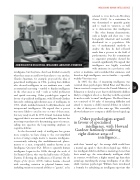
   JOHN MCCARTHY IN HIS ARTIFICIAL INTELLIGENCE LABORATORY AT STANFORD
referred to it in his book Hereditary Genius (1869). As a statistician, he was determined to quantify genius and to track its variation, as well as to demonstrate that intelligence – like other human characteristics, such as height and chest size – was biologically inherited and normally distributed in a population. His use of mathematical methods to analyse the data he had collected made him a pioneer in the field of psychometrics, but his commitment to eugenicist principles skewed his research significantly. He argued that intelligence was highly correlated with eminence in a profession, such
 Other psychologists argued in favour of specialised
intelligence, with Howard Gardner famously outlining
eight distinct areas of intelligence ...
with their “mental age”. An average child would have a mental age equal to their chronological age, whilst a less intelligent child would have a mental age lower than their actual age. An extraordinarily intelligent child, in contrast, would have a higher mental age than their actual age, matching the average intelligence of an older child. German psychologist William Stern introduced a formula for calculating an intelligence quotient that
35


