


Page 51 - Monocle Quarterly Journal Vol 3 Issue 2 Spring
P. 51
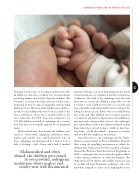
Malnourished and often abused, the children were raised in overcrowded, unhygienic institutions where neglect and cruelty were well-documented. Life in these orphanages was characterised by a lack of food, a lack of clothing, a lack of heat, and a lack of medical
attention. Perhaps even more devastating was the dearth of mental and sensory stimulation and the total absence of affection. The walls of the orphanages were bare and there were no toys for the children to play with or books for them to read. Children were left to lie in cribs and beds, physically weak and mentally vacant, staring at the ceiling for hours on end. Babies were not cradled when they cried, and older children were not given attention or comfort of any kind. So deprived were the children of any emotional connection that visitors to the orphanages have repeatedly noted how the children swarmed around them when they arrived, trying to climb in their laps, hug them, or hold their hands – desperate to connect with an adult who might care about them.
ROMANIAN ORPHANS AND THE POWER OF NEGLECT
   Romania, in the hopes of boosting population growth. In addition to this law, a “celibacy tax” was introduced, penalising families that had less than five children. The Securitate, or secret police, kept a close eye on the people, inspecting women for signs of pregnancy and reporting illegal abortions. However, many families were unable to provide for the children who were born as a result of the decree and had no choice but to abandon them to the care of the State. By 1989, there were estimated to be 170 000 children stranded in orphanages in a country that had been economically crippled by its tyrannical leader.
 One such visitor to the orphanages was Dr Charles Nelson, a neuroscientist at Boston Children’s Hospital. After seeing the appalling environments in which the children were being raised, Dr Nelson and his colleagues initiated the Bucharest Early Intervention Programme in 2000, to investigate the emotional and cognitive effects of these living conditions on child development. The study involved 136 infants and toddlers between 6 and 31 months old from Romanian orphanages, who were randomly assigned to either enter high-quality foster
 Malnourished and often abused, the children were raised
in overcrowded, unhygienic institutions where neglect and
cruelty were well-documented.
49


