


Page 62 - Monocle Quarterly Journal Vol 3 Issue 2 Spring
P. 62
MONOCLE QUARTERLY JOURNAL | DEEP LEARNING
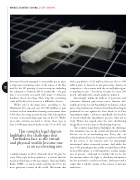
  Attorneys General managed to successfully put in place a temporary restraining order on the release of the files used for the 3D printing of various weapons, including the schematic to build an AR-15 assault rifle – the gun that is notoriously associated with many of America’s deadliest school shootings. How long this restraining order will hold out for, however, is difficult to foresee.
Whilst school shootings have, according to the Washington Post, exposed over 187 000 children to gun violence in their immediate learning environment since 1999, these shootings are just the tip of the iceberg when it comes to the much larger gun issue in the US. Whilst up-to-date statistics are hard to obtain, there were at least 33 000 gun-related deaths in the US in 2015 and
with a population of 325 million, there are close to 300 million guns in America at any given time. Yemen, in comparison – the country with the second highest gun- to-population ratio – has about 65 guns for every 100 people, although with a much smaller population.
Interestingly, unlike the millions of passionate and sometimes fanatical gun-owners across America who readily quote the Second Amendment in defence of their gun-toting inclinations, Defense Distributed has largely predicated its case against the State based on its First Amendment rights – and more specifically, the freedom of speech which this amendment protects. After all, as Cody Wilson has argued since the start, distributing design files is not the same as distributing weapons.
This complex legal dispute highlights the challenges that lawmakers face as the virtual and physical worlds become one at an accelerating rate. Every day, our ordinary physical lives are being more and more affected by the power of the internet and our increasingly intertwined online connected systems. And whilst the case of 3D printed guns has starkly revealed this problem in the public sphere, it is still regarded as a rather unique case at present – although it certainly will not be the last instance where the right to distribute information has the potential to result in violence, lawlessness and a reality that is wholly outside of the control of national authorities.
 This complex legal dispute highlights the challenges that
lawmakers face as the virtual and physical worlds become one
at an accelerating rate.
a similar number in 2013. And with about 90 guns for every 100 people in the population – a statistic that has nearly doubled since 1968 according to National Public Radio (NPR) – it can be safely said that the US is the most gun-crazy country in the world. This means that
60


