


Page 69 - Monocle Quarterly Journal Vol 3 Issue 2 Spring
P. 69
vision has successfully provided vehicles the ability to very accurately sense their environment and to navigate ever more safely, all without any input from a human driver. And in banking, AI has made great strides in identifying patterns pertaining to fraud, tax evasion, terrorist funding and money laundering; tackling an unprecedented mountain of financial and personal data far better and far more quickly than any human possibly could. In the continued desire for governments worldwide to make use of their banking systems, the individual participating banks themselves – as extensions of the State – have been coerced into essentially performing the monitoring and reporting of abuses within the financial system on behalf of the government. This has placed a significant burden of cost and time onto banks, which continue to attempt to act as private enterprises in a liberal free market economy and seek equity investment in ever more turbulent times – and it is AI that could possibly relieve banks from this significant stress.
Along with these remarkable breakthroughs, how- ever, has come a natural fear of the implications that this technology may have both in the long-run and the short-run. This fear of the unknown – and specifically
the implications of an artificial intelligence, or even super-intelligence – has manifested in the many “evil- AI” themed characters that have pervaded literature, television and films in the 20th and 21st centuries. From Frankenstein to The Terminator, this popular manifes- tation of an artificial super-intelligence gone rogue has demonstrated our inherent deep-rooted anxiety towards our own creations.
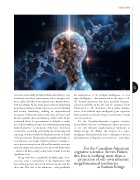
For the Canadian-American cognitive scientist, Steven Pinker, this fear is nothing more than a projection of our own inherent megalomaniacal tendencies as human beings. For Pinker, the creation of a super- intelligence that instinctively tries to subjugate or destroy the human race is illogical, as it is in fact us – as products
For the Canadian-American cognitive scientist, Steven Pinker, this fear is nothing more than a
projection of our own inherent megalomaniacal tendencies
as human beings.
CONCLUSION
   67


