


Page 20 - Builder Brief November 2025 Issue
P. 20
T R E N D S
HOW DIVERSE IS
THE CONSTRUCTION
WORKFORCE?
Diversifying the construction labor force remains
a key priority amid persistent skilled labor shortages.
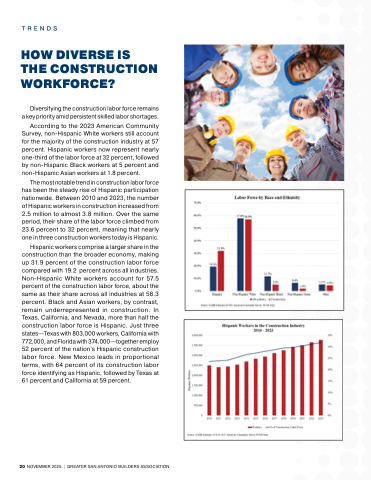
According to the 2023 American Community
Survey, non-Hispanic White workers still account
for the majority of the construction industry at 57
percent. Hispanic workers now represent nearly
one-third of the labor force at 32 percent, followed
by non-Hispanic Black workers at 5 percent and
non-Hispanic Asian workers at 1.8 percent.
The most notable trend in construction labor force
has been the steady rise of Hispanic participation
nationwide. Between 2010 and 2023, the number
of Hispanic workers in construction increased from
2.5 million to almost 3.8 million. Over the same
period, their share of the labor force climbed from
23.6 percent to 32 percent, meaning that nearly
one in three construction workers today is Hispanic.
Hispanic workers comprise a larger share in the
construction than the broader economy, making
up 31.9 percent of the construction labor force
compared with 19.2 percent across all industries.
Non-Hispanic White workers account for 57.5
percent of the construction labor force, about the
same as their share across all industries at 58.3
percent. Black and Asian workers, by contrast,
remain underrepresented in construction. In
Texas, California, and Nevada, more than half the
construction labor force is Hispanic. Just three
states—Texas with 803,000 workers, California with
772,000, and Florida with 374,000—together employ
52 percent of the nation’s Hispanic construction
labor force. New Mexico leads in proportional
terms, with 64 percent of its construction labor
force identifying as Hispanic, followed by Texas at
61 percent and California at 59 percent.
20 NOVEMBER 2025 | GREATER SAN ANTONIO BUILDERS ASSOCIATION


