


Page 23 - Sonoma County Gazette Sept 2017
P. 23
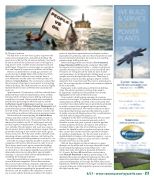
By Thomas Cochrane
The bad news is we now have a party in power who
push our legislative representatives for higher royalties, especially for California, and insist those funds be set aside for environmental cleanup in the event of any resulting pollution from drilling activities.
wants more oil production and offshore drilling. The good news is that for the oil and gas industry to actually be able to drill off the California coast it will require a long process with a sizable amount of paperwork and public input. This gives us several steps we can take to slow and hopefully even prevent offshore oil drilling.
Before drilling permits are issued an Environmental Impact Statement (EIS) must be conducted. The public
has input at several opportunities — when it is proposed, at public meetings for a first draft, and at final draft time. Of course, we will point out the need for more studies
and information. No drilling fluids, drilling mud, or rock samples are to be dumped into the ocean. Then there is
the question of where are they going to dispose of these materials? Not in our backyard! We want no unlined open pits. We want no injection of fluids into formations adjacent to the water table.
There is no doubt there is oil and gas out there: oil sand outcrops in Arena Cove, offshore basins stretch the length of the California coast, and the known
rock formations are the same ones which produce oil offshore in Santa Barbara. We can however contest that the amount of oil and gas is uneconomic in warranting offshore drilling. The offshore basins are narrow, highly faulted, thicker sections of Pleistocene un-productive rocks, etc.
Exploratory wells (wildcats) are drilled from drilling ships. The safety regulations of these ships need to
be vigorously examined as this problem was already highlighted in the Gulf of Mexico blowout.
Approximately 15 exploratory wells have already been drilled offshore north of Santa Barbara. None of them found a prolific oil field or more drilling and leasing would have occurred. We have both state and federal jurisdictions governing the offshore region, and the California Coastal Commission regulates uses along the adjoining shore. Offshore National Monuments and protected areas prevent drilling north of Santa Barbara to Point Arena. We need to set up, extend, or annex the rest of offshore northern California into protected zones.
If successful in finding large amounts of economic reserves of oil and gas, a Production Platform for the offset and production drilling will need to be constructed. This is another time when public input is permitted and should be used to contest these proposals and secure further environmental protection. We would be able to see these from shore (thus hurting tourism), the platforms would
sit inside commercial shipping lanes, they would interfere with fish and bird migration patterns, etc.
We should work toward getting the Gualala River estuary and other northern rivers included as part of
the offshore protected zones. The seismic lines the oil industry has offshore are 10 –15 miles apart and only produce regional interpretations of the geology from very old data. The oil industry will want new, state-of- the-art seismic data to define exploratory targets. We can protest the shooting of new seismic lines with a good chance of success. Ah-h the poor whales, the baby seals, migrating salmon, sea birds, abalone, crab fishing, the sport and commercial fishing industry, tourism, etc., etc.
A pipeline to the shore will be proposed. We can easily contest that one on environmental grounds, and it’s doubtful anyone will grant a permit to put the pipeline on their property. Then the oil industry will settle for
Once the oil and gas industry decides it wants to drill, companies will need to obtain leases in order to do so. These leases must be put up for competitive bidding. This will disclose to us where they want to drill. We
oil tanker ships to take the oil to refineries and on to market. We should be able to regulate and specify when they cannot dock in their mission to get the oil in light
of weather considerations, etc. We also need to insist on double-hulled oil tankers with American registry – e.g. no offshore companies whom we cannot locate if a lawsuit becomes necessary at some point!
can then draw in the adjacent neighbors as particularly interested parties in providing their input at public meetings – a process which has the added benefit of extending the nomination period.
With all these hurdles for the oil industry to jump through, we should be able to leverage the public’s right
to have input throughout a protracted process – one
which may delay and stall any proposed drilling for
10 –15 years. By then, BP should have evolved into a
truly Beyond Petroleum company; green energy will dominate the energy production businesses by then, the demand for petroleum will be significantly reduced,
and environmentalists will occupy the White House and legislatures. With the health of our fragile coastline at stake, we must all be part of this imperative process and continue this fight step by step.
Since the lease bidding is competitive, it will attract several different companies. We can then examine the record of some of these companies and their past environmental disasters. We can provide input based on this information regarding the proposed terms of the leases, and the royalties the companies currently pay to states and the federal government. We need to
9/17 - www.sonomacountygazette.com - 23


