


Page 47 - Sonoma County Gazette Sept 2017
P. 47
A Guide to the Night Sky
September 2017
By Tre Gibbs
Welcome Fall! On September 22nd at 12:53 pm, the Northern Hemisphere welcomes the return of Autumn.By now, you probably have noticed the days getting shorter as summer slips away. If you are particularly observant, you may have also noticed the sunrise and/or sunset moving farther and farther southward, which, by the way, is what’s causing the amount of daylight to wane while the nights gradually get longer. As the sunrise and sunset continue their journey southward on their respective horizons, the Equinoxes signal the time when the sun rises due east and sets due west, causing both the Northern and Southern Hemispheres to receive equal amount of daylight and night. In fact, the word Equinox is a latin word meaning “Equal Night”. After the 22nd though, the sun will continue its southward journey until late December, when it stops, turns around and heads north again.
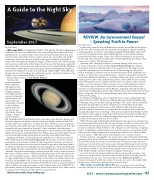
Saturn is the
prominent planet
in the night sky,
although by now,
the quintessential
ringed gas giant
has slipped further
west as it ultimately
will head into the
glare of the sun,
rendering it invisible
to sky watchers
until it slips into
our eastern pre-
dawn skies. Saturn
is huge – almost
as big as Jupiter.
But remember that it’s practically twice as far away from Earth as Jupiter, and therefore appears not nearly as bright, making it slightly harder to find. This
is where the moon comes in as a useful tool. Since the moon, sun and planets all travel the same path in the sky, and since the moon completes one full orbit around Earth every month (or “moonth”), there are times when the moon travels the night sky with each individual planet. The evening of the 26th is the night that the moon, orbiting Earth every 28 days, pairs up with mighty Saturn. Look for faint but steady glowing Saturn just below the almost half moon.
Speaking of Saturn, an amazing 20 year expedition is coming to an end. In 1997, NASA launched the Cassini Spacecraft. Its mission, to travel to Saturn and explore its spectacular system of rings and moons. Saturn is so far away that it took the spacecraft seven years to reach the gas giant. Reaching Saturn in 2004, Cassini has been sending home amazing photos, information leading to incredible scientific achievements and fascinating discoveries for more than a decade. The spacecraft though is running out of fuel, and, in order to protect the moons of Saturn which could harbor potential signs of life, the spacecraft has one last daring mission – The Grand Finale. 22 dives between Saturn and its rings, gathering new data about Saturn, closer than ever before until on its last dive, on September 15th, Cassini will plunge into Saturn’s atmosphere, burn up and become part of the planet itself. Here is a link to a great animated video, which I encourage everyone to see and share: vimeo.com/210782375 So this month, when you look upat Saturn, know that in many ways, there is more to what you are seeing than what meets your Earthly eye.
REVIEW: An Inconvenient Sequel
– Speaking Truth to Power
This is what’s known as The Winter Solstice.
Opening with a montage of photos of climate change with voice-over
of various criticisms of Gore and his Climate Reality Project, it shifts to Greenland. There his meeting with a Swiss scientist sets the stage for how much has changed since the earlier movie. While boating on a lake, they
talk of walking on it when it was an ice sheet 30 years earlier. Trekking over another ice sheet, they see a small moulin – a nearly vertical shaft formed by water percolating through the ice – and then a large one where water furiously rushing down carves out a path through the ice. Since 2000, the level of the
ice has dropped 12 meters, graphically shown by two photos of the research station – one of it sitting on the ice and one now on stilts high above the ice.
By Tish Levee
I came away from the new Al Gore movie simply astonished by the power
of this film, the concepts, the conversations, the graphics, and the stunning cinematography. In contrast with An Inconvenient Truth (2006), Gore’s first movie, the sequel has fewer charts (although they are excellent) and more powerful emotional content. There’s less of Vice President Gore’s personal stories and more interactions and stories with people being affected by what Gore is now calling “the climate crisis.”
Until next month, keep looking up!
9/17 - www.sonomacountygazette.com - 47
We follow Gore as he travels around the world to areas hard hit by the climate crisis, presenting his Climate Reality Leadership training. In Miami, where they’re lifting the roads, he talks with the mayor and others who’ve lived there a long time, all while wading through knee-deep water, despite pumps continuously going.
In Tacloban, Philippines, where Super Hurricane Haiyan demolished this capital of Leyte in 2013, killing over 6200 people and causing $12 billion plus in damages, he gives another training. Footage of the storm and its aftermath, often shot by individuals on their cell phones, is devastating. Profoundly moving are videos the former mayor shot of him and his family breaking
into the ceiling of their home to escape while flood waters and winds swirl through the upper story. Listening to him and a young Climate Reality trainee share their stories against a backdrop of the storm’s devastation is difficult, as is watching him and Gore walking through a huge graveyard, where rough wooden crosses practically touch each other.
While the message of An Inconvenient Sequel is the same as its predecessor, it’s more poignant and told with even more urgency. Early on, Gore warns that while there’ve been huge increases in the intensity of the climate crisis, we need to not despair. Because there’s a lot of hope, too; we’re nearing a “tipping point” in challenges to the climate crisis. Like the trainees we learn about the many positive things happening to mitigate the climate crisis. We learn that we, too, need to “Fight like your world depends on it,” because it does!
Science, statistics, and graphics are woven into scenes of the Climate Reality trainings. More than 12,000 have attended trainings in over 125 countries since the first 50 trainees met in the Gore family barn in Tennessee after the first movie, an event which many trainees say motivated them to get involved. The three-day training is free; Gore donated the profits from both movies and the books they’re based on, his Nobel Prize money (won for the 1st movie), and other funds totaling nearly $3 million to support this project.
As in the first movie, there’re links for taking action at the end plus a site where you can download a quick 10-slide version of Gore’s training to make presentations of your own. Get more ideas from “10 Days of Action” at inconvenientsequel.tumblr.com/action. It was great to see, in the credits, that all the energy involved in making the movie was offset.
This movie is not to be missed! Like it’s predecessor, it can change your life, and the lives of all you know and love, and those you’ve never met.


