


Page 219 - JAPN1001
P. 219
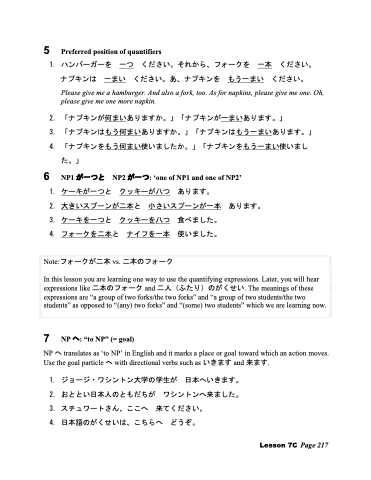
5 Preferred position of quantifiers
1. ハンバーガーを 一つ ください。それから、フォークを 一本 ください。
  ナプキンは 一まい ください。あ、ナプキンを もう一まい ください。
Please give me a hamburger. And also a fork, too. As for napkins, please give me one. Oh, please give me one more napkin.
2. 「ナプキンが何まいありますか。」「ナプキンが一まいあります。」
3. 「ナプキンはもう何まいありますか。」「ナプキンはもう一まいあります。」
4. 「ナプキンをもう何まい使いましたか。」「ナプキンをもう一まい使いまし
た。」
6 NP1 が一つと NP2 が一つ: ‘one of NP1 and one of NP2’
1. ケーキが一つと クッキーが八つ あります。
2. 大きいスプーンが二本と 小さいスプーンが一本 あります。
3. ケーキを一つと クッキーを八つ 食べました。
4. フォークを二本と ナイフを一本 使いました。
Note:フォークが二本 vs. 二本のフォーク
In this lesson you are learning one way to use the quantifying expressions. Later, you will hear expressions like 二本のフォーク and 二人(ふたり)のがくせい. The meanings of these expressions are “a group of two forks/the two forks” and “a group of two students/the two students” as opposed to “(any) two forks” and “(some) two students” which we are learning now.
7 NP へ: “to NP” (= goal)
NP へ translates as ‘to NP’ in English and it marks a place or goal toward which an action moves.
Use the goal particle へ with directional verbs such as いきます and 来ます.
1. ジョージ・ワシントン大学の学生が 日本へいきます。 2. おととい日本人のともだちが ワシントンへ来ました。 3. スチュワートさん、ここへ 来てください。
4. 日本語のがくせいは、こちらへ どうぞ。
                           Lesson 7C Page 217


