


Page 23 - teachers.PDF
P. 23
Test-retest reliability. A test-retest reliability coefficient is obtained by administering the same test twice and correlating the scores. In concept, it is an excellent measure of score consistency. One is directly measuring consistency from administration to administration. This coefficient is not recommended in practice, however, because of its problems and limitations. It requires two administrations of the same test with the same group of individuals. This is expensive and not a good use of people’s time. If the time interval is short, people may be overly consistent because they remember some of the question and their responses. If the interval is long, then the results are confounded with learning and maturation, that is, changes in the persons, themselves.
Split-half reliability. As the name suggests, split-half reliability is a coefficient obtained by dividing a test into halves, correlating the scores on each half, and then correcting for length (longer tests tend to be more reliable). The split can be based on odd versus even numbered items, randomly selecting items, or manually balancing content and difficulty. This approach has an advantage in that it only requires a single test administration. Its weakness is that the resultant coefficient will vary as a function of how the test was split. It is also not appropriate on tests where speed is a factor (that is, where students’ scores are influenced by how many items they reached in the allotted time).
Internal consistency. Internal consistency focuses on the degree to which the individual items are correlated with each other and is thus often called homogeneity. Several statistics fall within this category. The best known are Cronbach’s alpha, the Kuder- Richardson Formula 20 (KR-20) and the Kuder-Richardson Formula 21 (KR-21). Most testing programs that report data from one administration of a test to students do so using Cronbach’s alpha, which is functionally equivalent to KR-20.
The advantages of these statistics are that they only require one test administration and that they do not depend on a particular split of items. The disadvantage is that they are most applicable when the test measures a single skill area.
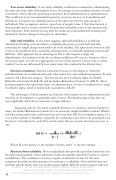
Requiring only the test mean, standard deviation (or variance), and the number of items, the Kuder-Richardson formula 21 is an extremely simple reliability formula. While it will almost always provide coefficients that are lower than KR-20, its simplicity makes it’s a very useful estimate of reliability, especially for evaluating some classroom-developed tests. However, it should not be used if the test has items that are scored other than just zero or one.
Where M is the mean, k is the number of items, and σ 2 is the test variance.
Alternate-form reliability. Most standardized tests provide equivalent forms that can be used interchangeably. These alternative forms are typically matched in terms of content and difficulty. The correlation of scores on pairs of alternative forms for the same examinees provides another measure of consistency or reliability. Even with the best test
and item specifications, each test would contain slightly different content and, as with test-
Rudner, L. and W. Schafer (2002) What Teachers Need to Know About Assessment. Washington, DC: National Education Association.
From the free on-line version. To order print copies call 800 229-4200
18


