


Page 46 - teachers.PDF
P. 46
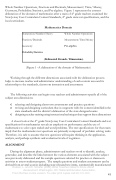
Whole Number Operations, Fractions and Decimals, Measurement/ Time/ Money, Geometry, Probability/Statistics, and Pre-algebra. Figure 1 represents the content delineation of the domain of mathematics after a team of 4th grade teachers examined the New Jersey Core Curriculum Content Standards, 4th grade state test specifications, and the local curriculum.
Mathematics Domain
Numeration/Number Theory Fractions/Decimals Geometry Probability/Statistics
Whole Number Operations Measurement/Time/Money Pre-algebra
(Delineated Strands / Dimensions)
(Figure 1 –A delineation of the domain of Mathematics)
Working through the different dimensions associated with the delineation process helps to increase teacher and administrator understanding of each content area and its relationship to the standards, classroom instruction and assessment.
The following activities can begin once teachers and administrators specify all of the subject area dimensions:
C selecting and designing classroom assessments and practice questions
C revisinganddesigningcurriculumthatiscongruentwiththecontentidentifiedinthe
state standards and the district’s delineation of the state designed exams
C designing teacher training using instructional techniques that support these dimensions
A closer look at the 4th grade New Jersey Core Curriculum Content Standards and test specifications for mathematics reveals an emphasis on performance and the use of mathematics to solve open ended and word problems. The test specifications for that exam imply that the mathematics test questions are primarily composed of problem solving tasks. Therefore, it is safe to assume that test questions will require thinking in the application, analysis, and perhaps synthesis and evaluation levels of cognition.
ALIGNMENT
During the alignment phase, administrators and teachers work to identify, analyze, generalize, and describe the links between the various elements associated with the subject area previously delineated and the sample questions selected for practice or classroom activities to assess student progress. The sample questions and student assessments can be
derived from several sources including state released test items, commercially manufactured
Rudner, L. and W. Schafer (2002) What Teachers Need to Know About Assessment. Washington, DC: National Education Association.
From the free on-line version. To order print copies call 800 229-4200
41


