


Page 64 - teachers.PDF
P. 64
One does not need to know U.S. history in order to be attracted to the answer, b.
Other rules that we might list are generally commonsensical, including recommendations for independent and important items and prohibitions against complex, imprecise wording.
WRITING OPTIONS
Following the construction of the item stem, the likely more difficult task of generating options presents itself. The rules we list below are not likely to simplify this task as much as they are intended to guide our creative efforts.
1. Be satisfied with three or four well constructed options. Generally, the minimal improvement to the item due to that hard-to-come-by fifth option is not worth the effort to construct it. Indeed, all else the same, a test of 10 items each with four options is likely a better test than a test with nine items of five options each.
2. Construct distractors that are
comparable in length, complexity and
grammatical form to the answer,
avoiding the use of such words as
"always," "never," and "all." Adherence
to this rule avoids some of the more
common sources of biased cueing. For
example, we sometimes find ourselves
increasing the length and specificity of
the answer (relative to distractors) in
order to insure its truthfulness. This,
however, becomes an easy-to-spot clue
for the testwise student. Related to this
issue is the question of whether or not
test writers should take advantage of
these types of cues to construct more
tempting distractors. Surely not! The
number of students choosing a
distractor should depend only on
deficits in the content area which the
item targets and should not depend on
cue biases or reading comprehension differences in "favor" of the distractor.
3. Options which read "none of the above," "both a. and e. above," "all of the above," _etc_., should be avoided when the students have been instructed to choose "the best answer," which implies that the options vary in degree of correctness. On the other hand, "none of the above" is acceptable if the question is factual and is probably desirable if computation yields the answer. "All of the above" is never desirable, as one recognized distractor eliminates it and two recognized answers identify it.
Rudner, L. and W. Schafer (2002) What Teachers Need to Know About Assessment. Washington, DC: National Education Association.
From the free on-line version. To order print copies call 800 229-4200
59
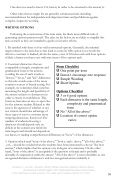
Stem Checklist
U One point per item
U Doesn’t encourage rote response U Simple Wording
U Short Options
Options Checklist
U 3 or 4 good options
U Each distractor is the same length,
complexity and grammatical
form
U No “All of the above”
U Location of correct option varies


