


Page 72 - teachers.PDF
P. 72
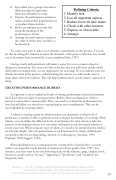
Defining Criteria
1. Identify task
2. List all important aspects
3. Reduce list to fit time frame 4. Check with other teachers 5. Express as observable
6. Arrange
C Ifpossible,havegroupsofteachers think through the important behaviors included in a task.
C Expresstheperformancecriteriain terms of observable pupil behaviors or product characteristics.
C Don't use ambiguous words that cloud the meaning of the performance criteria.
C Arrangetheperformancecriteriain the order in which they are likely to be observed.
You may even wish to allow your students to participate in this process. You can do this by asking the students to name the elements of the project/task that they would use to determine how successfully it was completed (Stix, 1997).
Having clearly defined criteria will make it easier for you to remain objective during the assessment. The reason for this is the fact that you will know exactly which skills and/or concepts that you are supposed to be assessing. If your students were not already involved in the process of determining the criteria, you will usually want to share them with your students. This will help students know exactly what is expected of them.
CREATING PERFORMANCE RUBRICS
As opposed to most traditional forms of testing, performance-based assessments don't have clear-cut right or wrong answers. Rather, there are degrees to which a person is successful or unsuccessful. Thus, you need to evaluate the performance in a way that will allow you take those varying degrees into consideration. This can be accomplished by creating rubrics.
A rubric is a rating system by which teachers can determine at what level of proficiency a student is able to perform a task or display knowledge of a concept. With rubrics, you can define the different levels of proficiency for each criterion. Like the process of developing criteria, you can either utilize previously developed rubrics or create your own. When using any type of rubric, you need to be certain that the rubrics are fair and simple. Also, the performance at each level must be clearly defined and accurately reflect its corresponding criterion (or subcategory) (Airasian, 1991; Popham, 1995; Stiggins, 1994).
When deciding how to communicate the varying levels of proficiency, you may wish to use impartial words instead of numerical or letter grades (Stix, 1997). For instance, you may want to use the following scale: word, sentence, page, chapter, book. However, words such as "novice," "apprentice," "proficient," and "excellent" are frequently used.
Rudner, L. and W. Schafer (2002) What Teachers Need to Know About Assessment. Washington, DC: National Education Association.
From the free on-line version. To order print copies call 800 229-4200
67


