


Page 79 - teachers.PDF
P. 79
theevaluation of a broader category of tasks. If the purpose of a given course is to develop a student's oral communication skills, a general scoring rubric may be developed and used to evaluate each of the oral presentations given by that student. This approach would allow the students to use the feedback that they acquired from the last presentation to improve their performance on the next presentation.
If each oral presentation focuses upon a different historical event and the purpose of the assessment is to evaluate the students' knowledge of the given event, a general scoring rubric for evaluating a sequence of presentations may not be adequate. Historical events differ in both influencing factors and outcomes. In order to evaluate the students' factual and conceptual knowledge of these events, it may be necessary to develop separate scoring rubrics for each presentation. A "Task Specific" scoring rubric is designed to evaluate student performances on a single assessment event.
Scoring rubrics may be designed to contain both general and task specific components. If the purpose of a presentation is to evaluate students' oral presentation skills and their knowledge of the historical event that is being discussed, an analytic rubric could be used that contains both a general component and a task specific component. The oral component of the rubric may consist of a general set of criteria developed for the evaluation of oral presentations; the task specific component of the rubric may contain a set of criteria developed with the specific historical event in mind.
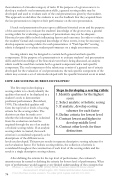
HOW ARE SCORING RUBRICS DEVELOPED?
The first step in developing a
scoring rubric is to clearly identify the
qualities that need to be displayed in a
student's work to demonstrate
proficient performance (Brookhart,
1999). The identified qualities will
form the top level or levels of scoring
criteria for the scoring rubric. The
decision can then be made as to
whether the information that is desired
from the evaluation can best be
acquired through the use of an analytic
or holistic scoring rubric. If an analytic
scoring rubric is created, then each
criterion is considered separately as the
descriptions of the different score
levels are developed. This process results in separate descriptive scoring schemes for each evaluation factor. For holistic scoring rubrics, the collection of criteria is considered throughout the construction of each level of the scoring rubric and the result is a single descriptive scoring scheme.
After defining the criteria for the top level of performance, the evaluator's
attention may be turned to defining the criteria for lowest level of performance. What
type of performance would suggest a very limited understanding of the concepts that
Rudner, L. and W. Schafer (2002) What Teachers Need to Know About Assessment. Washington, DC: National Education Association.
From the free on-line version. To order print copies call 800 229-4200
Steps in developing a scoring rubric
1. Identify qualities for the highest score
2. Select analytic or holistic scoing 3. If analytic, develop scoring
schemes for each factor
4. Define criteria for lowest level 5. Contrast lowest and highest to
develop middle level
6. Contract other levels for finer
distinctions
74


