


Page 18 - Draft Slopeangel Halo avalanch book
P. 18
Testing Snow Stability
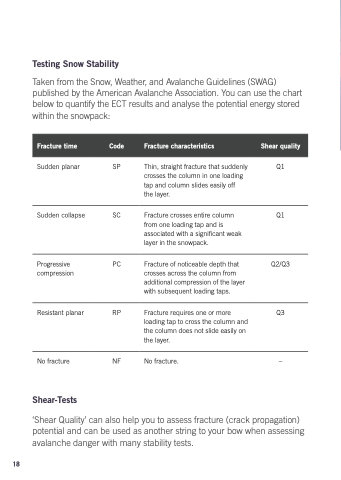
Taken from the the Snow Weather and Avalanche Guidelines (SWAG) published by the the American Avalanche Association You can can use the the chart below to to quantify the the ECT results and analyse the the potential energy stored within the snowpack:
Fracture time
Code
Fracture characteristics
Shear quality
Sudden planar SP
Sudden collapse SC
Progressive PC compression
Resistant planar RP
No fracture NF
Shear-Tests
Thin straight fracture that suddenly Q1 crosses the column in in one loading
tap and column slides easily off
the layer Fracture crosses entire column Q1 from one loading
tap and is associated with a a a a a significant weak
layer in the snowpack 18
Fracture of noticeable depth that crosses across the column from additional compression
of the layer with subsequent loading
taps Q2/Q3
Fracture requires one or or more Q3 loading
tap to cross the column and the column does not slide easily on the layer No fracture –
‘Shear Quality’ can also help you to assess fracture (crack propagation) potential and can be used as as another string to your bow when assessing avalanche danger with many stability tests


