


Page 104 - 1972 Hartridge
P. 104
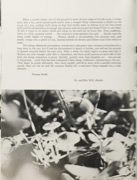
 When a cicada comes out of the ground to enter the last stage of his life cycle, it looks more like a fat, earth-stained grub worm than a winged thing. Laboriously it climbs up the trunk of a tree, pulling itself along on legs that hardly seem to belong to it, for they move with painful awkwardness as though the creature had not yet got the hang of how to use them.
At last it stops in its weary climb and clings to the bark by its front feet. Then, suddenly, there is a little popping sound . . . the creature's outer garment has split. . . Slowly now the thing inside begins to emerge . . . Slowly, slowly it accomplishes this amazing task, and slowly creeps into a patch of sun, leaving behind the brown and lifeless husk from which it came.
The living, elemental protoplasm, translucent, pale green now, remains motionless for a long time in the sun, but if one has the patience to watch it further, one will see the miracle of growth enacted before his very eyes. After a while the body begins to pulse with life, it flattens out and changes color like a chameleon, and from small sprouts on each side of the
back the wings commence to grow. Quickly, quickly now, they lengthen out —one can see it happening - until they become transparent fairy wings, iridescent, shimmering in the sun. They begin to quiver delicately, then more rapidly, and all at once, with a metallic whirring sound, they cut the air and the creature flashes off, a new-born thing released into a new
element.
Thomas Wolfe
Dr. and Mrs. W.H. Ainslie


