


Page 32 - 1959 Hartridge
P. 32
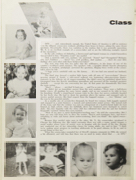
1979 . . . and, miraculously enoiifrli, the United States of America is still in existence —so the diliRcnt census-men realized, plodding from house to house, asking the same dreary questions. Occasionally, there was variation in the routine, but it was generally unexciting. Mr. X. is an excellent example of a census-taker and so are the following examples typical of his encounters.
In the safe confines of Suburbia, a brown-eyed and haired woman in a faded housedress was revealed to him. “Whaddya want?” she snarled.
“Just a moment with you, madam,” he answered. “Name? Age? Occupation? Biologi.st, you say? Children . . . three? Ves, well goodbye. And madam . . . don’t let your little darlings slice each other with those broken test tidies!” '
The next stop took him ten miles into the wilderness, to the home of one of the country’s wealthiest mink ranchers. The rancher’s wife, a haughty blonde bravely attempting elegance in muskrat, grudgingly amswered the questions, flinging these words at the census- taker when he left:
“I hope you’re satisfield with my life history. . . It’s too bad you missed my husband, ‘Ebenezer’.”
The third stop showed a modest little house with all sorts of“ever-so-dainty” flowers growing around it. Inside, a soft-voiced redhead was instructing ultra-precocious kinder garteners in the delicate art of copper-enameling. She didn’t seem too perturbed about being interrupted from this fiercely stimulating atmosphere and answered all the standard questions dutifully . . . except the one concerning her age. At that point she dramatically fled from the room saying:
“Don’t . . . please . . . not that! It hurts me . . . and I’m so very sensitive.”
He didn’t get an immediate answer from the next residence. There were a half-dozen kiddie voices, all giggling the same horsey giggle, and no one seemed to be able to hear his knocking. Finally a round-faced woman came to the door, her nerves evidently frazzled by her lively clan. He had to shout his questions above the uproar, and managed only to receive partial an.swers. His final request from thehaggard woman. . . two “Dristan” and the way to the peaceful outside.
In a nearby city of seventy-five thousand, he found two women, both happily married and engaged in a joint business: a taxicab and motorscooter rental service. The taxicab half of the team said that the venture was just an enlargement of a hard-to-break habit she had formed in high school, when she faithfully drove her boyfriend (now husband) to school daily. The tiny brunette with the china doll face informed him that she and her husband frequently “scooted ”before they were married.
“Most of my time is spent kindergarten-teaching now,” she told the census-taker. But I hope my .sons will learn how to drive the scooter. They’re such hand.some boys, and there’s .something .so virile and heroic about motor-scootering, don’t you think?” She sighed roman tically.
Because they needed extra men in the cities, Mr. X., the census-taker, jet-planed to Chicago the following day. His initial encounter there was with a warm, genial woman; a .social worker whose views of society were in keeping with the trends of the day. Having ju.st conducted one of her citizenship cla.sses for young adults, she said to him: “I think we’re making great progress in teaching adolescents to be good citizens, to fit in, and to accept things as they are.”
J„ i
a bit affronted, and told him that there was no need to worry about that . . . in 1979.”
When the census-taker reminded her of Orwell’s ominous comments in 1984, she seemed


