


Page 22 - USAP Connected_WINTER 2017
P. 22
Luckily, patients can play as much of a role in reducing their need for a blood transfusion as can their care team. One way is by building up the patient’s blood counts prior to surgery.
Starting at least a few weeks before surgery, patients should be eating foods rich in iron and vitamins. If they’re anemic (low red blood cell count), they may wish to talk to their doctor about growth factors (medications that cause bone marrow to produce more blood cells). However, growth factors do pose risks. The decision to take these medicines should be made through a conversation between the patient and their physician.
It’s important that patients and care providers agree on and
take steps toward optimal blood management strategies with the goal of avoiding the need for transfusion. In our pursuit of improving patient outcomes and the overall treatment and healing experience, blood transfusions should be the alternative, not the standard.
Optimal blood management means every drop of blood counts. Integrated PBM is a team strategy that requires administration, physicians, nurses and patients work together toward the common goal of better patient care and outcomes. Blood conservation policies and protocols, a core PBM team led by physicians, continuing clinical education and patient education are staples of good PBM.
THE COST OF POOR BLOOD MANAGEMENT
In addition to better quality care and outcomes for patients, blood management helps to better sustain our U.S. blood supply, increases operating room throughput, helps to minimize unnecessary surgical costs and improves physicians’ skills5.
IT’S IMPORTANT THAT PATIENTS AND CARE PROVIDERS AGREE ON AND TAKE STEPS TOWARD OPTIMAL BLOOD MANAGEMENT STRATEGIES WITH
THE GOAL OF AVOIDING THE NEED FOR TRANSFUSION.
Blood costs include more than just the cost of collecting products. Hospitals pay to test patients before transfusion, store blood, dispense it from the blood bank and give it to patients. This requires safety checks at every step. When a patient
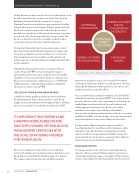
OPTIMIZING COAGULATION
INTERDISCIPLINARY BLOOD CONSERVATION MODALITIES
IMPROVED PATIENT OUTCOMES
PATIENT-CENTERED DECISION MAKING
MANAGING ANEMIA
“* Source: Hofmann, A., Farmer, S., Shander, A., “Five Drivers Shifting the Paradigm from Patient- Focused Transfusion Practice to Patient Blood Management.” The Oncologist, 2011:16(suppl3):3-11
experiences an adverse event, costs increase for treatment and longer hospital stays, and their overall experience declines drastically. Avoiding unneeded transfusions saves these costs and prevents unnecessary side e ects.
Precise and meticulous surgical techniques using all available methods of hemostasis are vital to PBM6. Care teams should pay close attention to blood loss opportunities so that they can rapidly diagnose and arrest blood loss in all situations, and employ appropriate intraoperative blood conservation modalities in an evidence-based fashion. All available intraoperative and postoperative autologous blood conservation modalities should be considered, while care teams measure and assess hemoglobin loss and control diagnostic blood loss7.
It is important to address anemia as early as possible in hospitalized patients to avoid the need for transfusion, either during their stay, after discharge or during future hospital admissions. Elective surgery patients should be checked for anemia at least four weeks prior to surgery to allow su cient time for any necessary anemia management.
MANAGING ANEMIA
To manage anemia, create methods for early and ongoing detection with your patients. Enhance physiologic tolerance
of anemia by minimizing oxygen consumption. Employ timely evidence-based pharmaceutical and nutritional intervention to
22 WINTER 2017 | CONNECTED
PATIENT BLOOD MANAGEMENT | FROM PAGE 20


