


Page 10 - 2025 Impact Report
P. 10
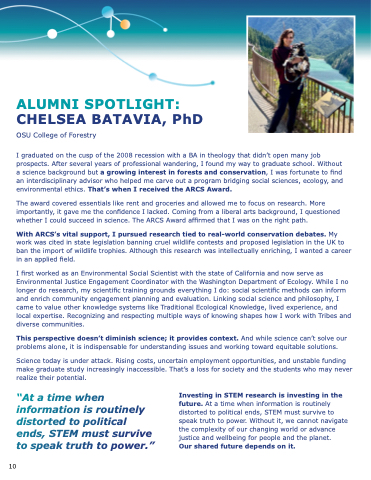
ALUMNI SPOTLIGHT:
CHELSEA BATAVIA, PhD
OSU College of Forestry
I graduated on the cusp of the 2008 recession with a BA in theology that didn’t open many job
prospects. After several years of professional wandering, I found my way to graduate school. Without
a science background but a growing interest in forests and conservation, I was fortunate to find
an interdisciplinary advisor who helped me carve out a program bridging social sciences, ecology, and
environmental ethics. That’s when I received the ARCS Award.
The award covered essentials like rent and groceries and allowed me to focus on research. More
importantly, it gave me the confidence I lacked. Coming from a liberal arts background, I questioned
whether I could succeed in science. The ARCS Award affirmed that I was on the right path.
With ARCS’s vital support, I pursued research tied to real-world conservation debates. My
work was cited in state legislation banning cruel wildlife contests and proposed legislation in the UK to
ban the import of wildlife trophies. Although this research was intellectually enriching, I wanted a career
in an applied field.
I first worked as an Environmental Social Scientist with the state of California and now serve as
Environmental Justice Engagement Coordinator with the Washington Department of Ecology. While I no
longer do research, my scientific training grounds everything I do: social scientific methods can inform
and enrich community engagement planning and evaluation. Linking social science and philosophy, I
came to value other knowledge systems like Traditional Ecological Knowledge, lived experience, and
local expertise. Recognizing and respecting multiple ways of knowing shapes how I work with Tribes and
diverse communities.
This perspective doesn’t diminish science; it provides context. And while science can’t solve our
problems alone, it is indispensable for understanding issues and working toward equitable solutions.
Science today is under attack. Rising costs, uncertain employment opportunities, and unstable funding
make graduate study increasingly inaccessible. That’s a loss for society and the students who may never
realize their potential.
“At a time when
information is routinely
distorted to political
ends, STEM must survive
to speak truth to power.”
Investing in STEM research is investing in the
future. At a time when information is routinely
distorted to political ends, STEM must survive to
speak truth to power. Without it, we cannot navigate
the complexity of our changing world or advance
justice and wellbeing for people and the planet.
Our shared future depends on it.
10


