


Page 7 - Demo-1
P. 7
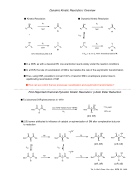
Dynamic Kinetic Resolution: Overview
! Kinetic Resolution
OH kF X
R2 R1 fast R2 R1
A
+
OH kS X
R2 R1 slow R2 R1
B
50% theoretical yield of A
! In a DKR, as with a classical KR, one enantiomer reacts slowly under the reaction conditions
! In a DKR, the rate of racemization of SM is fast relative the rate of the asymmetric transformation
! Dynamic Kinetic Resolution
OH kF X
R2 R1 fast R2 R1
krac
A
OH kS X
! Thus, using DKR, possible to convert 100% of racemic SM to enantiopure product due to equilibrating racemization of SM
! How can we control the two processes: racemization and asymmetric transformation?
First Reported Chemical Dynamic Kinetic Resolution: !-Keto Ester Reduction ! Tai observes DKR phenomenon in 1979
R2 R1 slow R2 R1
B
If krac > kF >> kS 100% theoretical yield of A
O O
MeO
Et
Me
O OH
cat. (R,R)-Tartaric Acid—MHNi 2
MeO 3 Me
H2 Et (2S, 3R)
71% yield 80% ee
! (2S) isomer attributed to influence of catalyst on epimerization of SM after complexation but prior to reduction
Ni*
Ni* 2 H2 2 2
OO OO
OOH OOH
MeO
krac
Me
MeO Me Et
kinv
MeO Me Et
MeO
Me
Et
Et (2S, 3S)
Ni*
(2S, 3R)
OOH OOH
OO OO
Ni* 2 H2 2 2
MeOMe MeOMe MeOMeMeOMe
Et Et
Et Et (2R, 3R) (2R, 3S)
Tai, A. Bull. Chem. Soc. Jpn., 1979, 52, 1468.


