


Page 37 - Demo samer flip book
P. 37
Investopedia.com – the resource for investing and personal finance education.
flow measures or EBITDA, which is a measure of earnings before the subtraction of depreciation. However, depreciation typically cannot be ignored because it serves a valuable purpose: it sets aside an annual amount (a sinking fund, if you will) for the maintenance and replacement of fixed assets.
Because depreciation is an accounting convention, you sometimes see an alternative label: "economic depreciation." This is an adjusted depreciation that represents the "true" amount that a company needs to allocate annually in order to maintain and replace its fixed asset base. In theory, economic depreciation corrects for errors in both directions. Consider the depreciation of real estate, which is usually an over- charge, reducing the real estate's book value--calculated by the original investment minus accumulated depreciation--to something far below its fair market value. On the other hand, consider a key piece of equipment that is subject to rapid inflation. Its eventual replacement will cost more than the original, in which case depreciation actually under-charges the expense. If depreciation expense is large relative to other expenses, it often helps to ask whether the charge approximates the replacement value of the assets. Determining this can be difficult, but sometimes the footnotes in a company's financial documents give explicit clues about future expenditures.
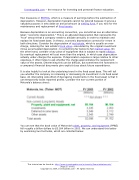
It is also helpful to look at the underlying trend in the fixed asset base. This will tell you whether the company is increasing or decreasing its investment in its fixed asset base. An interesting side effect of decreasing investments in the fixed asset is that it can temporarily boost reported profits. Consider the non-current portion of Motorola's balance sheet:
You can see that the book value of Motorola's plant, property, and equipment (PP&E) fell roughly a billion dollars to $5.164 billion in 2003. We can understand this better by examining two footnotes, which are collected below:
This tutorial can be found at: http://www.investopedia.com/university/financialstatements/ (Page 37 of 66)
Copyright © 2004, Investopedia.com - All rights reserved.


