


Page 45 - Demo samer flip book
P. 45
Investopedia.com – the resource for investing and personal finance education.
funding decisions, and therefore will often offer clues about a company's future prospects.
Debt is Cheaper than Equity--to a Point
Capital structure refers to the relative proportions of a company's different funding sources, which include debt, equity, and hybrid instruments such as convertible bonds (discussed below). A simple measure of capital structure is the ratio of long- term debt to total capital.
Because the cost of equity is not explicitly displayed on the income statement-- whereas the cost of debt (interest expense) is itemized--it is easy to forget that debt is a cheaper source of funding for the company than equity. Debt is cheaper for two reasons. First, because debtors have a prior claim if the company goes bankrupt, debt is safer than equity and therefore warrants investors a lower return; for the company, this translates into an interest rate that is lower than the expected total shareholder return (TSR) on equity. Second, interest paid is tax deductible to the company; and a lower tax bill effectively creates cash.
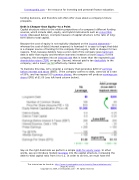
To illustrate this idea, let's consider a company that generates $200 of earnings before interest and taxes (EBIT). If the company carries no debt, owes tax at a rate of 50%, and has issued 100 common shares, the company will produce earnings per share (EPS) of $1.00 (see left-hand column below).
Say on the right-hand side we perform a simple debt-for-equity swap. In other words, say we introduce modest leverage into the capital structure, increasing the debt-to-total capital ratio from 0 to 0.2. In order to do this, we must have the
This tutorial can be found at: http://www.investopedia.com/university/financialstatements/ (Page 45 of 66)
Copyright © 2004, Investopedia.com - All rights reserved.


