


Page 8 - Demo samer flip book
P. 8
Investopedia.com – the resource for investing and personal finance education.
shareholders, then we should use 'free cash flow to equity' (FCFE), which is the analog to net earnings and would be best for a price-to-cash flow ratio (P/CF).
If we want cash flows to all capital investors, we should use 'free cash flow to the firm' (FCFF). FCFF is similar to the cash generating base used in economic value added (EVA). In EVA, it's called net operating profit after taxes (NOPAT) or sometimes net operating profit less adjusted taxes (NOPLAT), but both are essentially FCFF where adjustments are made to the CFO component.
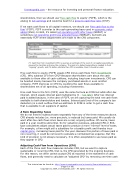
(*) Cash flow from investment (CFI) is used as an estimate of the level of net capital expenditures required to maintain and grow the company. The goal is to deduct expenditures needed to fund "ongoing" growth, and if a better estimate than CFI is available, then it should be used.
Free cash flow to equity (FCFE) equals CFO minus cash flows from investments (CFI). Why subtract CFI from CFO? Because shareholders care about the cash available to them after all cash outflows, including long-term investments. CFO can be boosted merely because the company purchased assets or even another company. FCFE improves on CFO by counting the cash flows available to shareholders net of all spending, including investments.
Free cash flow to the firm (FCFF) uses the same formula as FCFE but adds after-tax interest, which equals interest paid multiplied by [1 – tax rate]. After-tax interest paid is added because, in the case of FCFF, we are capturing the total net cash flows available to both shareholders and lenders. Interest paid (net of the company's tax deduction) is a cash outflow that we add back to FCFE in order to get a cash flow that is available to all suppliers of capital.
A Note Regarding Taxes
We do not need to subtract taxes separately from any of the three measures above. CFO already includes (or, more precisely, is reduced by) taxes paid. We usually do want after-tax cash flows since taxes are a real, ongoing outflow. Of course, taxes paid in a year could be abnormal. So for valuation purposes, adjusted CFO or EVA- type calculations adjust actual taxes paid to produce a more "normal" level of taxes. For example, a firm might sell a subsidiary for a taxable profit and thereby incur capital gains, increasing taxes paid for the year. Because this portion of taxes paid is non-recurring, it could be removed to calculate a normalized tax expense. But this kind of precision is not always necessary. It is often acceptable to use taxes paid as they appear in CFO.
Adjusting Cash Flow from Operations (CFO)
Each of the three cash flow measures includes CFO, but we want to capture sustainable or recurring CFO, that is, the CFO generated by the ongoing business. For this reason, we often cannot accept CFO as reported in the statement of cash flows, and generally need to calculate an "adjusted CFO" by removing one-time cash
This tutorial can be found at: http://www.investopedia.com/university/financialstatements/ (Page 8 of 66)
Copyright © 2004, Investopedia.com - All rights reserved.


