


Page 8 - OffGrid East Coast Special Edition 2016
P. 8
“We did this
to make a meaningful difference in the world. There is an imperative
to take action
to reduce climate change. Everyone who has the means should be taking action.”
– Roger Boutilier
Off-Grid? On-Grid? Your choice.
Either way, solar energy delivers.
By Wayne Groszko
Maybe you have always wanted to live off-grid? But what if you live in town and you already have a grid-connected home? You can still make your home solar powered, without having to disconnect from the grid, using the arrangement known as net metering.
Meet Joan and Roger Boutilier. They have a grid-connected, net metered 5-kilowatt solar photovoltaic (PV) array on their home in Wolfville, Nova Scotia. Installed in 2014, the PV array produces electricity that powers their home on sunny days.
Energy credits, significant savings
Net metering means that anytime there is extra solar power, it feeds out through the electric meter and into the grid, powering their neighbours’ homes, gaining
a credit for the Boutilier family on their electric bill. When there is not enough solar power, they use their credit to buy the electricity back. All of this
happens automatically, with no need for user intervention or maintenance of batteries. The net result is a significant savings on their electric bill.
Joan and Roger are very happy with their solar array. Their sophisticated online monitoring system shows them that in a 12-month operating period,
the array has produced over 5,000 kilowatt-hours (kWh) of electricity. In Nova Scotia, that means their solar array has already saved over 3.5 metric tonnes of greenhouse gas emissions from being emitted into the atmosphere,
which is a big part of the reason they installed the system.
One in series of steps
For Joan and Roger, the solar PV installation is just one of a series of steps they have taken
to reduce their environmental footprint. In 2008, they installed a solar water heater on the roof, which is saving them lots of energy for their domestic hot water supply. Then in 2009 they had an Efficiency Nova Scotia energy assessment. Based on those recommendations, they have increased the insulation in their attic and basement, saving even more energy. They have also installed an electric thermal storage unit, to take advantage of less expensive night-time electricity with the time-of-use rate available in Nova Scotia.
After attending several courses and seminars on sustainable energy alternatives, they decided to take the next step and go for solar electricity. After some planning and a few hurdles, they are now successful producers of solar power at their home.
First winter was tough
The first winter for their PV array was a tough one. Anyone who was in Nova Scotia in February and March of 2015 would know why. Deep snow and intense ice conditions blocked the panels, cutting output for almost two months. But the array suffered no damage, and bounced back in the spring, still providing 91% of its projected annual output over the whole year.
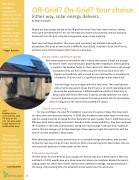
ftftttttttttfttttttttttftfttffttttfttttttttJoan
Boutilier at her home with the solar PV array on the roof. Her solar water heater stands in the middle of the array
“It’s so fun!
The best thing
is to see how much energy it’s making online. I like to check and see which panels are doing well.”
- Joan Boutilier
off the grid
8


