


Page 175 - June 2016
P. 175
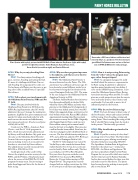
                                  Shari (center with trophy), pictured with APHA Hall of Fame inductee Ray Graves (right, with trophy) and (left to right) Bruce Grider, Vickie Neumann, Dan and Kaye Jones,
Karen Utecht (second from right) and Pancho Villarreal.
Barracuda, a 2013 sorrel tobiano stallion bred and owned by Shari, is a grandson of the horsewoman’s great Wheel Six Fortunes mare and one of the last sons of APHA $5 Million Sire Judys Lineage.
APHA: How is it unique seeing Paint racing from the “other” side as the program man- ager, rather than participant?
Shari: As a program manager, I’m really involved behind the scenes as a representative for Paint racing. In addition to administer-
ing three major futurities and two derbies, I serve on the APHA Racing Committee. I also attend the Oklahoma Quarter Horse Racing Association meetings when possible. It’s really given me a wide perspective on how the associa- tions and tracks operate, rules, finances and social media. I’ve been able to meet a lot of influential people in the business.
APHA: Why do you love Paint racing? Shari: I’ve been fortunate to know some of the best breeders, owners and trainers involved
in Paint racing. I love breeding, owning and racing Paints. There’s nothing like seeing a field full of colorful Paints racing down the track or in the pasture. The fans really get excited.
APHA: Why should others get involved in Paint racing?
Shari: If you like a variety of color, then I encourage you to buy a Paint. The Paint indus- try continues to grow, offering several major futurities with purses exceeding $100,000. The Speedhorse Graham Paint & Appaloosa Futurity is the richest race—estimated at $250,000—for Paints and Appaloosas. We also have a Speedhorse Triple Crown Bonus Program for two year olds, which was won for the first time last year by Painted Turnpike. And we have several derbies for three year olds and stakes races for older horses. The purses have become lucrative, making it more profit- able to own Paints.
APHA: Why do you enjoy breeding Paint Horses?
Shari: I’ve always enjoyed studying pedi- grees, statistics, breeding and raising the foals. It’s more of a challenge with Paints. I’m not only breeding for racing speed, but color, too. I’ve had more solid Paints over the years, so get- ting color is like an added bonus. I especially like tobianos.
APHA: Tell us about your involvement with the Oklahoma Paint Futurity, PSBA and Pot O’ Gold.
Shari: I became involved with the Oklahoma Paint Futurity in 2008 when the APHA Racing Department asked if I would administer the race. I manage the nomination payments, eligibility lists, purse summaries and awards. It’s taken some hard work, but with much success the entries and added money have increased each year. It had a record purse of $145,600 in 2015.
I took over the PSBA—American Paint Classic—and Pot O’ Gold programs in 2011, which were previously administered by Henry and Linda Bowlan. My goals were the same as the Oklahoma Paint Futurity:
I wanted the races to grow in numbers and money, making it more of an incentive for breeders to raise foals by Paint stallions. The added money recently increased from $35,000 to $50,000 for 2016.
I really give much of the credit to Ray Graves, the original executive secretary for the PSBA, and the Bowlans, who played a major role in the success of the PSBA/Pot O’ Gold programs for many years. I’m just trying to make them bigger and better for the future of Paint racing.
APHA: Why are these programs important to the industry, and what are your favorite memories of each?
Shari: The Oklahoma Paint Futurity is the most historical race for Paints. The 50th anniversary was celebrated a few years ago. It’s been located at several different tracks, but is best known for being the first futurity of the year at Remington Park since 1991. The name of the race changed to the Oklahoma Paint & Appaloosa Futurity in 2014.
The Paint Stallion Breeders Association was first discussed unofficially in the late 1960s when Ray Graves, Bill Maher and some other guys met at the Oklahoma City fairgrounds. A lot of ideas were kicked around, but it was Bill Maher who suggested doing a restricted race for foals by Paint studs only. Ray and Bill called an organizational meeting where Ray was made the executive secretary for the PSBA. Originally, only Regular Registry Paints could run in it; Paint stallion owners paid an annual enroll- ment fee for foals to be eligible. There was also
a stallion/breeder bonus added. Years later, the rules were changed to allow solid Paint-breds to run, too. The first official futurity took place in 1976, and a derby was added in 1977. Both races were moved to Remington Park in 1989.
The Pot O’ Gold program was started by Virdin Royce, who owned the famous Paint stallion Easy Jet Too. It was also a restricted race for foals by Paint stallions only. The first race took place in 1983 at Ross Meadows. Five years later, the purse reached a record $130,000. It was located at Blue Ribbon Downs for 21 years before moving to Will Rogers Downs. The program has recently changed with no stallion restrictions for 2016, so it’s now open to all Paints and Appaloosas.
 SPEEDHORSE, June 2016 173
 paint horse bulletin
courtesy APHA
Shari Burger


