


Page 247 - Demo
P. 247
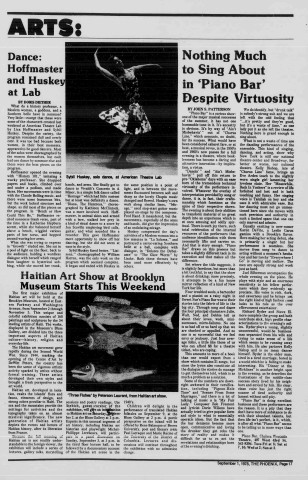
Hoff mas terand Huskeat LabBY DORIS DIETHERWhat do a history professor, a Moslem woman, a goddess, and a Southern belle have in common? Very little%u2014except that these were some of the characters created last weekend at American Theatre Lab by Lisa Hoffmaster and Sybil Huskey. Despite the variety, the program remained dull and overly cute. It was too bad because both women, in their best moments, appeared to be good dancers. Most of the solos were choreographed by the women themselves, but each had one dance by someone else and these were the best pieces on the program.Hoffmaster opened the evening with %u201c History 101,%u201d imitating a wacky professor. $he dropped papers and books, climbed over and under a podium, and made faces. Her movements were in time with the Claude Bolling music, and there were some humorous bits, but the work lacked structure and shape, as did most of the pieces on the program. In %u201c Bench or How Could This Be,%u201d Hoffmaster recited nonsense blank verse, part of the time in a Katherine Hepburn accent, while she balanced herself above a bench, wiggled various parts of her torso, and hopped around waving her arms.What she was trying to express in %u201cGrowth%u201d eluded me. She sat in a pool of light on the floor, back to the audience, holding a wordless dialogue with herself which ranged from laughter to hysterical sobbing, while she moved her trunk,Sybil Huskey, solo dance, at American Theatre Labhands, and arms. She finally got to dance to Vivaldi%u2019s Concerto in A Minor, in a simple folk dance called %u201c Homage%u201d which had little content but at least was definitely a dance. %u201cDiana, The Huntress,%u201d choreographed by Kathleen McClintock, was a more involved work. Hoffmaster, in animal skins and armed with a bow, stalked her prey in a kind of ritual dance to a score by Jon Scoville employing bird calls, guitar, and what sounded like a recorder. This gave Hoffmaster more opportunity to show off her dancing, but she did not seem at ease in the style.Sybil Huskey fared better. %u201c Liaisons,%u201d choreographed by William Harren, was the only work on the program which seemed complete. It began and ended with Huskey inHaitian Art Show at BrooklynMuseum Starts This WeekendThe first major exhibition of Haitian art will be held at the Brooklyn Museum, located at Eastern Parkway and Washington Avenue, from September 2 through November 5. This unique and colorful exhibition consists of 160 paintings and sculptures by the 54 leading artists of Haiti. The works, displayed in the Museum%u2019s Blum Gallery, are divided into the three important aspects of Haitian culture%u2014history, religion and everyday life.The Haitian art movement grew rapidly during the Second World War. Since 1944, marking the opening of the Centre d%u2019Art by DeWitt Peters, the country has been the scene of vigorous artistic activity sparked by artists without formal training. These artists developed their own styles and brought a fresh perspective to the art world.Haitian art, developed in isolation, exalts the islands%u2019 flora and fauna, elements of design, and strong colors peculiar to Haiti. The sea and the mountains provide the settings for activities and the topography takes on% an almost mystical significance. The new generation of Haitian artists depicts the events and heroes of Haitian history, after its liberation from France.n ____ _____ i t __ J* ..tt ____________ ru v w a u o c u iv > t u n m V 'a i iJ ii g U iHaitian art is not readily understandable to the foreign viewer, the exhibition will include a series of lectures, gallery talks, storytelling%u2018Three Fishes%u2019 by Peterson Laurent, from Haitian art show.sessions and poetry readings. Ute Stebich, guest > curator of the exhibition, will give ah intttiduction to Haitian art on S aturday.J^em - ber 2, at the Blum Gallery at 2 p.m. Experts in this unusual segment of art history, including Haitian art historian and playwright MichelPhillippe Lerebours, will participate in a panel discussion on Sunday, September 3, at 3 p.m. in the third floor lecture hall, to be followed by a documentary account o f the Haitian art scene in theto Sing Aboutin %u2018Piano Bar%u2019Despite Virtuositythe same position in a point of light, and in between the movements fluctuated between soft and sharp as the lovely Chopin music changed and flowed. Huskey%u2019s own work along similar lines, %u201c Mirage,%u201d used stop-start guitar music played on-stage by the composer, Fred Hand. It meandered, but the movements, especially of the arms and hands, did give the impression of an undulating mirage.Huskey compressed the day%u2019s activities of a Moslem woman into a few minutes in %u201c La Salama,%u201d and portrayed a carrot-eating Southern belle at a ball, complete with dialogue, in %u201c Delores the Debutante%u201d to %u201c The Glow Worm%u201d by Lincke. Both these themes have been used more effectively by others.1940%u2019s.Children will delight in the performance of translated Haitian folktales on September 9, at the Blum Gallery at 2 p.m. A poetic perspective on the island will be offered by Rene Balanque of Brown University, poet and literary critic Paul Larraque and Marie Racine of i.iie University of ine District of Columbia. Lectures and discussions will continue throughout the exhibition with no admission charge.BY JOHN S. PATTERSON%u201c Piano Bar%u201d is a curious sho one of the major musical successes of the summer, it has not one hummable tune in it. It%u2019s ancestry is obvious. It%u2019s by way of %u201cAin%u2019t Misbehavin%u2019 %u201d out of %u201cChorus Line,%u201d which accounts, no doubt, for its success. What would have been considered cabaret fare, or at best, a musical revue, in the 1950%u2019s and 1960%u2019s now passes for a full evening in a theatre, where booklessness has become a daring and attractive innovation%u2014by implication, a virtue.%u201cDancin%u2019 %u2019%u2019 and %u201cAin%u2019t Misbehavin%u2019 %u201d pull off this return to pre-%u201cOklahoma%u201d days with an ease born of the tremendous technical virtuosity of the performers involved. Whatever the overlay of interpretation provided by song or dance, it is, in fact, their craftsmanship which functions as the spine of their respective shows. The evening is about their abilities to transform material of no great depth into an experience which is at once amusing and oddly spiritual. There is such joy there, such total celebration of the internal resources of the performers that audience identification with them necessarily lifts and carries us. And that is story enough. %u201cPiano Bar%u201d draws on this process but takes a slightly different tack in its execution and that makes all the difference.Set where the title suggests, it is slightly facetious, but more than a bit truthful, to say that the show is about drinking: more precisely, it attempts to be a fun house mirror reflection of a kind of New York bar life.Four troubled souls, a bartender and a pianist on a rainy night in ! Sweet Sue%u2019s Piano Bar weave their into the fabric of life in the big city. Through song and dance the four principal characters Julie, Walt, Ned, and Debbie tell us about their loves, work, minisuccesses, micro-failures. No one is so bad off or so hard up that we are shocked or appalled. And no one is so successful that we feel envy or jealousy. Just four average folks, a little like those of us who can afford $8 for a theatre ticket, who are coping.This amounts to more of a book than one would expect from a show which contains 21 songs, but since the lyrics also constitute all the dialogue the stories do manage to get themselves told, which is as much a problem as a solution.Some of the numbers are downright awkward in their versification, including %u201cPigeon-Hole Time%u201d and %u201cScenes From Some Marriages,%u201d and there is a lot of talking of music a la %u201cMy Fair Lady.%u201d Composer Rob Fremont and lyricist Dorie Willens have actually tried to give popular form and style to what is essentially operatic idiom. But the fact that the bar denizens become more open, communicative and loving the drunker they get robs the story of reality and makes it. difficult for us to re. iect the revelations and relationships born of the evening%u2019s drinking.We do identify, but %u201cdrunk talk\is nobody%u2019s strong suit and we are left with the odd feeling that %u201c...it%u2019s pretty and they%u2019re good, but it%u2019s a waste of time,%u201d as one lady put it as she left the theatre. Nothing here is grand enough to sing about.What is not a waste of time are the dazzling performances of the ensemble. This kind of singing, dancing, and acting, show why New York is still our national theatre center and Broadway, for better or worse, our national theatre. Kelly Bishop, late of %u201cChorus Line%u201d fame, brings an Eve Arden touch to the slightly worn single girl lamenting her loveless state. Her %u201cMeanwhile, Back In Yonkers%u201d is a review of life forfeited and lost and is both touching and funny. Her singing voice is Talullah on key and she uses it with admirable ease. But her dancing must not go unmentioned here since she moves with such precision and authority in such a limited space that one can only marvel and admire.Equally exciting is new-comer Karen DeVito, a Leslie Caron gamine with a Brooklyn flavor. Here making her acting debut, she is primarily a singer but her performance is seamless. She moves from song to dance to acting without a moment%u2019s hesitation and her torchy %u201cEverywhere I Go%u201d is moving and mellow. The men are equally strong and work just as hard.Joel Silberman accompanies the whole evening on the piano. He plays with style and an enormous sensitivity to his fellow performers which they evidently appreciate. His voice is rich, dark, and cavernous and he brings ust the right kind of high fashion rood looks to his role as the ever effervescent entertainer.Richard Ryder and Steve Elmore complete the group and both contribute slick, high profile characterizations to the evening%u2019s milieu. Ryder plays a young, slightly unsuccessful, would-be businessman separated from his wife and trying to make sense of a life which seems to be running away with him. He also partners Kelly Bishop and is no mean dancer himself. Ryder is the older man, tired in a tired marriage; bored in a world which he is failing to make interesting. His \Mirklines%u201d is another bright spot in the evening, as he describes the frustrations of the middle-class success story lived by his neighbors and envied by him. His clear, clean voice has just the right nuance of tired authority and lament without self-pity.%u201cPiano Bar\business and these performers are the reason. It is a pity that they don%u2019t have more of substance to do with their abundant talents, but then life isn%u2019t perfect, is it, which, is after all what %u201cPiano Bar%u201d seems to be telling us in more ways than one.D ! . . . D ___/''11_ %u25a0 ______ n r . %u2022 * - MMJIV , VUCIOCA ff CS19IUCTheatre, 407 West 43rd St. 541-8394. Tues-Fri at 8; Sat at 7,10; Wed at 2; Sun at 3.Dance: Nothing MuchSeptember 1,1978, THE PHOENIX, Page 17


