


Page 342 - Demo
P. 342
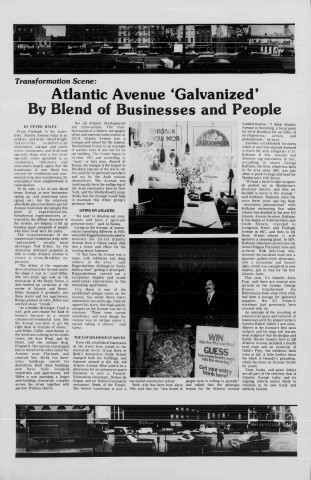
Transformation Scene:A t l a n t i c A v e n u e %u2018 G a l v a n i z e d %u2019B y B l e n d o f B u s i n e s s e s a n d P e o p l eBY PETER HALEYFrom Flatbush lo the waterfront , Atlantic Avenue today is an unlikely and lively- blend of light industrial, commercial wholesalers, antique and crafts stores, restaurants, and Arab food specialty shops with a few retail specialty stores sprinkled in as condiments. Oldtimers and newcomers largely agree that the transfusion of new blood has revived the residential and commercial st rip also transforming the at mosphere from neighborhood to cosmopolitan.To be sure, a lot of new blood keeps flowing as new businesses spring up (and sometimes later spring out), but the relatively affordable price merchants pay for Avenue real estate encourages this kind of experimentation. Residential experimenters, attracted by the offbeat character of the Avenue, are helping to fill up housing space alongside of people who have lived here for years.The transformations of the commercial-residential strip were %u201c galvanized,%u201d recalls local developer Ted Hilies, by the ultimately defeated proposal in 1970 to widen Atlantic Avenue to create a cross-Brooklyn expressway.%u201cThe defeat of the expansion drew attention to the Avenue and to the shape it was in,%u201d said Hilles, who two years ago took on the renovation of 304 Henry Street, a then burned out structure at the corner of Atlantic and Henry. Hilles changed it gradually into three stores and ten apartments. Being a pioneer of sorts, Hilles was worried about %u201ctrends.%u201d%u201cAs a builder-developer, 1 had to wait, pick and choose the kind of tenants because in a mixed commercial-residential area like the Avenue you have to get the right kind of mixture of stores,%u201d said Hilles. Hilles%u2019 contribution to the trend was to bring in two crafts stores, 100 Acre Wood, and By Hand, and one antique shop, Potpourri. His success encouraged him to travel to the other end of the Avenue, near Flatbush, and renovate Nos. 562-64, two threestory buildings slated for demolition. Both these buildings now have fully occupied storefronts and apartments, and Hilles is now pursuing a larger nine-building renovation complex across the street together with partner William Harris.Not all Atlantic developments are renovations. The transformation of a former newspaper office and onetime radio station at 552-54 Atlantic Avenue into a mosque and school for the Islamic Brotherhood Center is an example of another form of new use for an old building. The Center began in October 1977 and according to %u201ciman%u201d or holy man, Ahmed A1 Banna, I he mosque is the largest in Brooklyn and one of the few in the city paid for by personal members and not by the Arab nations themselves. The Avenue has traditionally been the wellspring of the Arab community here in New York, and the Brotherhood%u2019s iman thinks that the mosque would help to maintain this ethnic group%u2019s presence here.LIVING ON ATLANTIC%u201cWe want to develop our community and have a spiritual presence here,%u201d said A1 Banna.Living on the Avenue, of course, meant something different in 1970, when Bob Higginbothem decided to renovate No. 111-113 Atlantic Avenue from a Cuban social club into a home and office for his mailing-house business.%u201cAt that time the Avenue was a mess, with robberies and drug addicts in the area,%u201d said Higgenbothem. Although he %u201chad a helluva time%u201d getting it developed, Higgenbothem carved out a sumptious duplex and made substantial renovations in the remaining apartments.City Barn is one of the established antique stores on the Avenue, but owner Steve Gertz remembers ten years ago, when he opened his store, that high-quality antiques on the Avenue was not so common. %u201cThese were vacant storefronts, and even though the Avenue was an antique center it meant taking a chance,%u201d said Gertz.THE ESTABLISHMENT MOVESEven old, established businesses on the street have joined in the renovation move. Irving Berk of Berk%u2019s Automotive Trade School changed both his buildings and business around at 430, 438, 448 Atlantic Avenue. What used to be a showroom for an automotive parts business is now a FrenchVietnamese restaurant, Delices de Saigon, and an Italian-Continental restaurant, Seeds of the Future. The former warehouse is now asuccessful automotive school. people here is willing to gamble Berk, who has been here since and called that the principj 1940, said that the %u201cnew breed of reason for the Atlantic Avenutransformation. %u201cI think Atlantic Avenue is becoming a focal point for all of Brooklyn for an influx of intelligentsia, artists, and professionals,%u201d he says.Another established business which at one time seemed destined to leave the area altogether is D. Kalfaian & Son, oriental and domestic rug merchants. In fact, according to owner George Kalfaian, the firm, which has been in the area since 1907, was just about to pack its bags and head for Manhattan's 57th Street.%u201cWe had a lease to sign on space all picked out in Manhattan%u2019s decorator district, and then we decided to move to the Avenue,%u201d said Kalfaian. Business since the move three years ago has been %u201cabsolutely phenomenal%u201d with Kalfaian estimating that sales volume has doubled at his new 475 Atlantic Avenue location. Kalfaian & Son began at Schermerhorn and Smith Streets, traveled to Livingston Street and Flatbush Avenue in 1917, and then to 321 Dean Street%u2014where it still operates a cleaning plant. In 1974, Kalfaian%u2019s business moved into the former Regina Furniture store and architect Wids dela Coup transformed the run-down store into a spacious gallery-style showroom, with a mezzanine and theater lights which was completed in nine months, just in time for the first Atlantic Antic.This year, it%u2019s Atlantic Antic Four, and there are several new arrivals on the Avenue. George Krauss transformed his Bibliomania book store from what had been a storage for janitorial supplies. His 377 Atlantic storefront had previously been covered with tin.An example of the recycling of commercial space and turnover of businesses until the proper niche is found is Robert Albert%u2019s new store. Alberts is the Avenue%u2019s first neon sculptor and his shop will feature neon sculpture that he designs and builds. Recent tenants here at 228 Atlantic Avenue included a health food store and an extension of Child%u2019s Play, the childrens book store at 226. A little further down the block is Heandy%u2019s pawnshop, which has been an Avenue fixture for years.Neon, books, and pawn tickets are all part of the territory that is Atlantic Avenue today and its ongoing rebirth seems likely to continue in its own lively and unlikely fashion.


