


Page 380 - Demo
P. 380
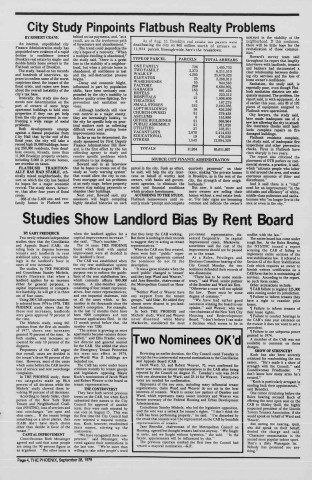
City Study Pinpoints Flatbush Realty Problemsn o ui Aug. 15, Brooklyn real estate taA payers were dead beating the city on $65 million worth of arrears on11,934 parcels. Borough-wide, here's the breakdown:TYPE OF PARCEL PARCELS TOTAL ARREARSONE FAM ILY 726 1,495,732TW O FAM ILY 2,373 6.21L510W ALK-UP 4,205 25,679,323ELEVATOR 25 2,208 913W AREHOUSES 55 944 563FACTORY 269 6,604 901G A R AG ES 163 881,424HOTELS 5 223 312HOSPITALS 21 1 006 609TH EATERS 6 167 276SM ALL STORES 252 2,440,386LOFT B U ILDIN GS 36 836,599%u2019CHURCH-OWNED 81 379,438ASYLUM S 6 153,886OFFICE BUILDINGS 21 368,964PUBLIC ASSEM BLY 21 281,820UTILITIES 37 158,351VACANT LOTS 2,070 2,414,033EDUCATIONAL 19 470,238OTHERS 1,543 12,084,329TOTALS 11,934 65,011,607SOURCE: CITY FINANCE ADMINISTRATIONBY ROBERT CRANEAn internal, unpublished city Finance Administration study has pinpointed new evidence of a rapid decline in confidence toward Brooklyn real estate by single- and double-family home owners in the Flatbush section of Brooklyn.The study, based on tax records and hundreds of interviews, appears to confirm some of the worst suspicions about the impact of the fiscal crisis, and raises new fears about the overall instability of the city%u2019s tax base.Ironically, the study also documents new determination on the part of owners of some large apartment buildings to hold onto properties if they can get help from the city government in confronting a wide range of social problems.Both developments emerge against a dismal projection from City Hall that by the end of the fiscal year, the city will take a record high 19,000 buildings, housing 250,000 residents, from deadbeat owners. Already, more than 11,900 Brooklyn property owners, including 3,000 in private homes, are overdue on taxes.FLATBUSH TR A D ITIO N %u00adALLY HAS HAD STABLE, eth nically mixed neighborhoods, the sort on which the city has banked its hopes for a major economic revival. The study shows, however, that after four years of fiscal crisis:-933 of the 5,400 one- and twofamily homes in Flatbush areof foreclosure and abandonment.%u201d-T h e trend could jeopardize the city%u2019s hopes of a recovery. %u201cWhen a multiple dwelling is abandoned,1%u2019 the study said, %u201cthere is a greht loss to the stability of a neighborhood, but when a private home is abandoned, all confidence is lost and the self-destruction process begins.%u201d-D ecay and economic blight, influenced in part by population shifts, have been seriously compounded by the city%u2019s inability to deliver quality crime-fighting, fire prevention and sanitation services.-Although landlords still view rent control as a major enemy, they are increasingly looking to the city for specific help on practical matters such as collecting difficult rents and getting home improvements loans.So far as can be determined, the study sponsored by First Deputy Finance Administrator Bill Howard, is the first effort by the tax collecting agency to study and resolve specific problems which contribute to tax dodging.Howard said in an interview that he hopes to create out of the study an %u201cearly warning system%u201d that would allow the city to confront mortgage and tax problems at an early stage, before property owners stop making payments or abandon their buildings.Next year, Howard said, city assessors will begin compiling highly detailed histories on eachparcel in the city. Such an effort, he said, will help the city intervene on behalf of worthy land owners, with banks and government agencies, to eliminate the social and financial conditions which produce foreclosures.ACCORDING TO THE STUDY, Flatbush homeowners until recently made \quarterly payments%u201d on thentaxes, making %u201cthe private homes in Brooklyn, as in the rest of the city, the strength of their neighborhoods.%u201dBut now, it said, \more owners are selling thenhomes without a real estate broker. %u2018For Sale%u2019 signs are becoming common and indicate the owner%u2019smistrust in the stability of theilVlgllK/V/l u i/v /u . Ai tlUO w u v u iu v v ,there will be little hope for the revitalization of those communities.%u201dHoward%u2019s survey team said throughout its report that lengthy interviews with landlords, tenants and bankers had documented a clear relationship between declining city services and the loss of home owner%u2019s confidence.Sanitation, the study said, is especially poor, even though Flatbush sanitation districts are adequately manned. The problem, the report said, is with equipment. As of earlier this year, only 68 of 132 pieces of equipment assigned to Flatbush were operational.City lawyers, the study said, have made inadequate use of a new law allowing the city to attach fire insurance checks until landlords complete repairs on fire damaged buddings.Flatbush residents complain, the study said, of inadequate fire inspections and other preventive checks. Fires in Flatbush have risen sharply in two years.The report also criticized the placement of OTB parlors on commercial streets, a practice, it said, which %u201cattracts people who loiter in and around the area, and create enormous amounts of litter and disturbance.%u201dAnd it said there is a %u201cvital%u201d need for an improvement %u201cin the attitudes and efficiency%u201d of white, middle-class policemen and sanitationmen who %u201cno longer live in the area or even in the city.%u201dStudies Show Landlord Bias By Rent BoardBY GARY FREDERICKTwo newly released independent studies show that the Conciliation and Appeals Board 1 (CAB), the ruling body in disputes between tenants and landlords in rent stabilized units, votes overwhelmingly in the landlord%u2019s favor in cases of rent increases.The studies, by THE PHOENIX and Councilman Stanley Michels, clearly illustrate that when a landlord applies for an increase either for general purposes, a capital improvement or comparative hardship, he will get it in three out of four cases.Using 200 CAB opinions randomly selected from 1976 to 1978, THE PHOENIX study shows that for these rent increases, landlords were given approval 79 percent of the time.The Michels study, using 661 opinions from the first six months of 1977, shows rent increases granted 70 percent of the time. In both studies, rent increases accounted for only 10 percent of the disputes.Proponents of the CAB argue that overall, cases are decided in the tenant%u2019s favor 90 percent of the time. However, most of the cases which come before the CAB involve less of service and rent overcharge complaints.In THE PHOENIX study, these two categories made up 86.6 percent of all decisions while the Michels%u2019 study showed them involving 90 percent of all decisions.According to Sandy Sidar, chairperson of the New York State Tenant and Neighborhood Coalition (NYSTNC), loss of services and rent overcharges %u201c are open and shut cases... If the tenant brings something on a silver platter, they (CAB) don%u2019t have much choice other than decide in favor of the tenant.%u201dCAPITAL IMPROVEMENTCouncilwoman Ruth Messinger agreed and said that some people are using the 90 percent figure as an argument. %u201c The other issue iswhen the landlord applies for a capital improvement increase,%u201d she said. %u201c That%u2019s touchier.%u201dThe 14 cases THE PHOENIX found which dealt with capital improvement were all decided in the landlord%u2019s favor.The CAB was established when the city rent stabilization system went into effect in August 1969. Its purpose was to enforce the guidelines of the rent stabilization law, which currently affects 800,000 tenants. A nine-member panel, consisting of four tenant representatives, four owner representatives, and one impartial chairman, rule on all the cases which, so far, number in the thousands since the board%u2019s conception. For example, in the last 12 months there have been 9200 complaints and rent increase applications filed. In the 12 month period before that, the number was 7200.%u201c The system is growing as more apartments become vacancy decontrolled,%u201d said Ellis Franke, executive director and general counsel for the CAB. She added that since the Emergency Tenant Protection Act went into effect in 1974, pre-World War II buildings are included too.The CAB has come under heavy criticism recently by tenant groups and legislators opposing Mayor Koch%u2019 s nominations of Jacob Ward and Robert Weaver to the board as tenant representatives.THE CONTROVERSYThey have both served previous terms on the CAB, but when Koch submitted their names to the City Council for approval of another term, they were each rejected by one vote on August 15. This was the first time the City Council had ever rejected a mayoral nomination. Koch, however, resubmitted their names, stirring up the controversy.%u201c We have recognized their competence,%u201d said Messinger, who voted against their nominations in the last vote. %u201c W e%u2019re more than willing to take other people%u2019s wordthat they keep the CAB working. But there is nothing in their records to suggest they're acting as tenant representatives.%u201dWhen the CAB was first created, there were four %u201c public%u201d representatives and opponents contend the nominees do not fit the description.%u201c It was a great mistake when the word %u2018public%u2019 changed to %u2018tenant%u2019 and they kept Ward and Weaver,%u201d said Jane Benedict, chairwoman of the Metropolitan Council on Housing.%u201c Neither Ward or Weaver have any support from the tenant groups,%u201d said Sidar. He added they almost never dissent in pro-landlord decisions.In both THE PHOENIX and Michels%u2019 study, Ward and Weaver never dissented while Marty Markowitz, considered the mostpro-tenant representative, dissented frequently. In capital improvement cases, Markowitz sometimes said the cost of the improvement should not be passed on to the tenant.At a Rules, Privileges and Elections Committee hearing of the City Council Monday, the two nominees defended their records of non-dissension.%u201c There has to be some consistency,%u201d said Ward, senior partner of the Domber and Ward law firm. %u201c Otherwise a court will not uphold the law. There must be some degree of certainty.%u201d%u2018 %u2018 We have had rather good success in winning the board to our opinion,%u201d said Weaver, who was vice-chairman of the New York City Housing and Redevelopment Board. %u201c I don%u2019t believe I can make a decision which seems to be inTwo Nominees OK%u2019dReversing an earlier decision, the City Council voted Tuesday to accept the two controversial mayoral nominations to the Conciliation and Appeals Board (CAB .Jacob Ward, 53, and Robert Weaver, 70, were confirmed for three year terms as tenant representatives to the CAB after being rejected by the Council on August 15. Tuesday%u2019s vote was 24-14 with one abstention for Ward, and 25-14 for Weaver. Twenty-two votes are needed for confirmation.Opponents of the two men, including many influential tenant organizations, claim Ward and Weaver do not act in the best interests of tenants. Ward is senior law partner of Dember and Ward, which represents many owner interests and Weaver was former secretary o f the Federal Housing and Urban Development Administration.Councilman Stanley Michels, who led the legislative opposition, said the vote was a setback for tenant%u2019s rights. %u201c I don%u2019t think the CAB has been performing properly,%u201d he said. %u201c I%u2019m disturbed by the result that tenants won%u2019t be represented on the CAB by bonafide representatives o f tenants.\Jane Benedict, chairwoman of the Metropolitan Council on Housing, agreed but thought tenants had won anyway. %u201c We fought in unity, and we fought without hysterics,%u201d she said. %u201c In the future, appointments will be influenced by this.%u201dThe previous rejection marked the first time the Council had vetoed a mayoral nomination.-G.F.conflict with the law.%u201dThe entire board has come under rough fire. At the Rules Hearing, the NYSTNC issued a report accusing the CAB of failing to implement entire sections of the rent stabilization law. It referred to Section 62 of the Rent Stabilization Code which requires an owner to furnish written certification on a CAB form that he is maintaining all services. According to the report, no such form exists.Other accusations include:1 CAB failure to register 325,000 units coming under its jurisdiction.1 Failure to inform tenants they have a right to examine prior losses.1 Failure to inform tenants of their lease rights.1 Failure to conduct hearings in the CAB%u2019s nine year existence on the excuse it does not want to set a precedent.5 Failure to use subpoena power granted in 1974.A member of the CAB was not available to comment on these charges.SHOW OF STRENGTH?Koch has also been severely criticized for resubmitting the two names. %u201c He%u2019s made it a show of strength with the Council,%u201d said Councilwoman Friedlander. %u201c I don%u2019t know how many arms he%u2019s twisted.%u201d%u201c Koch is particularly arrogant in sending back their appointments,%u201d said Benedict.One rumor circulating before the Rules hearing accused Koch of offering the next open seat on the CAB to Shirley Quill, the highly respected president of the Lincoln Towers Tenants Association, if she would speak on behalf of Ward and Weaver.out during tne hearing, Quill, who did speak on their behalf, denied the charge and said, %u201c Character - assassination is the second most popular indoor sport. That%u2019s a dirty Watergate lie. Nobody has promised me anything.%u201dft-----------M T U P ftUACMIV _____________________ r a ^ 3 I M L . r I I V U I 1 I A , 2S, 197S


