


Page 426 - Demo
P. 426
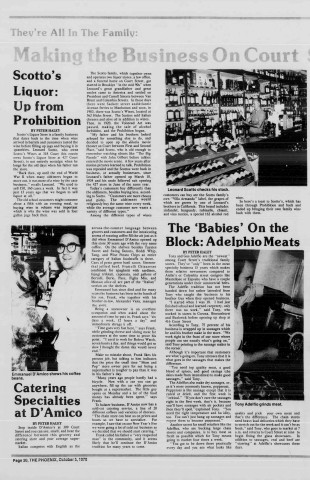
::. amii tLeonard Scotto checks his stock.Scotto%u2019sLiquor:Up fromProhibitionBY PETER HALEYSeotto%u2019s Liquor Store is a family business that dates back to the time when wine arrived in barrels and customers tasted the wine before filling up jugs and buying it in quantities. Leonard Scotto, who owns Scotto%u2019s Wines at 318 Court (his cousin owns Scotto%u2019s Liquor Store at 427 Court Street), is not entirely nostalgic when he longs for the old days when his father ran the store.%u201c Back then, up until the end of World War II when many oldtimers began to move out, it was more of a wine by the case business,%u201d recalls Leonard. %u201c We used to sell 150, 160 cases a week. In fact it was just 13 years ago that we began to sell liquor at all.%u201dThe old school customers might consume about a fifth with an evening meal, so buying wine in volume was important which is why the wine was sold in four gallon jugs back then.The Scotto family, which together owns and operates two liquor stores, a law office, and a funeral home on Court Street, got started in Brooklyn %u201c in the mid 90s%u201d when Leonard%u2019s great grandfather and great uncles came to America and settled on President and Carroll Streets between Van Brunt and Columbia Streets. In those days there were Sackett street andAtlantic Avenue ferries to Manhattan and soon, in 1903, there was Scotto%u2019s Wines, located at 562 Hicks Street. The Scottos sold Italian cheeses and olive oil in addition to wines. Then, in 1920, the Volstead Act was passed, making the sale of alcohol forbidden, and the Prohibition began.%u201c My father and his brothers looked arfound for something else to do, and decided to open up the /jloria movie theater on Court between First and Second Place,%u2019%u2019said Scotto, who is old enough to remember watching silents like %u201c The Big Parade%u201d with John Gilbert before talkies entered the movie scene. A few years after motion pictures learned to talk, Prohibition was repealed and the Scottos were back in business, or actually businesses, since Leonard%u2019s father opened up March 10, 1934 and his uncle followed suit opening the 427 store in June of the same year.Today%u2019s customers buy differently than the oldtimers, besides buying less, according to Scotto. %u201c Customers are more choosy and picky. The oldtimers would religiously buy the same wine every week, while the average customer now wants a variety of different types.%u201dAmong the different types of winescustomers can buy are the Scotto family%u2019s own %u201c Villa Armando%u201d label, the grapes of which are grown by one of Leonard%u2019s brothers in California. This brand includes zinfandel, burgundy, rubinello, chianti, and vino rustico, a special 162 alcohol redwine.So here%u2019s a toast to Scotto%u2019s, which has been through Prohibition and back and ended up bringing their own family wine back with them.Emmanuel D%u2019Amico shows his coffeebeans.C ateringS p ecia ltiesat D%u2019AmicoBY PETER HALEYStep inside D%u2019Amico%u2019s at 309 Court Street and you can see, smell, and hear the difference between this grocery and catering store and your average supermarket.Italian competes with English as theacross-the-counter language between grocers and customers and the intoxicating aroma of roasting coffee fill the air just as it did when Emmanuel D%u2019Amico opened up this store 30 years ago with the very same coffee. On the shelves besides Taystee Sweet and Swing Donuts, Reddi Whip, Tang, and Wise Potato Chips an entire category of Italian foodstuffs is there. Cans of pesto green basil sauce, SimmenIhal jellied beef, Frattelli Chiazzesse condiment for spaghetti with sardines, fujngi trifolati, caponata, and gallons of Bertolli, Berio, Pace, Figlia Mia, and Monaco olive oil are part of the %u201c Italian%u201d section on the shelves.Emmanuel has since died and for many years the business has been in the hands of his son, Frank, who together with his brother-in-law, Alexander Viola, manages the store.Being a storeowner is an overtime occupation and when asked about the amount of time he puts in, Frank says %u201c six days a week, 12 hours a day%u201d and immediately shrugs it off.%u201c Time goes very fast here,%u201d says Frank, while grinding cheese and slicing meat for customers at the same time to prove his point. %u201c I used to work for Bulova Watch, seven hours a day, and things would get so slow I thought the damn day would never end.%u201dMake no mistake about, Frank likes his present job, but talking to him indicates that the price the small time %u201c Mom and Pop%u201d store owner pays for not being a supermarket is tougher to pay than it was in his father%u2019s day.%u201c Many years ago people hardly had a bicycle. Now with a car you can go anywhere, fill up the car with groceries bought at a supermarket. The little guy opens on Monday and a lot of the food money has already been spent,%u201d says Frank.To bolster business, D%u2019Amico now has a cold-cut catering service, a line of 20 different coffees and varieties of cheeses. %u201c The chain store can beat us on prices and hours so we have to specialize. For example, I saw that on one New Year%u2019s Eve we were going a lot of cold cut business so we decided that we should start catering.%u201dFrank called his father a %u201c very respected man%u201d in the community, and it seems likely that he%u2019ll continue the D%u2019Amico tradition for many years to come.T h e %u2018B a b ie s %u2019 O n th eBlock: Adelphio MeatsBY PETER HALEYTony and Gus Adelfio are the %u201c newest%u201d among Court Street%u2019s traditional family stores. They%u2019ve %u201conly%u201d been in the meat specialty business 15 years which makes them relative newcomers compared to Aiello%u2019s or Columbia street emigres like Mastellone or Esposito who have a couple generations under their commercial belts.The Adelfio tradition has not been handed down but rather lateraled from Tony who taught the business to his brother Gus when they opened business.%u201c I started when I was 18. I had just finished school and learned carpentry, only there was no work,%u201d said Tony, who worked in stores in Corona, Bensonhurst and Bushwick before opening up shop at 416 Court StreetAccording to Tony, 75 percent of his business is wrapped up in sausages which he and his brother make in the store. %u201c We work right in the front of our store where people can see exactly what%u2019s going on,%u201d said Tony pointing to the sausage maker in the corner.Although it%u2019s important that customers see what%u2019s going on, Tony stresses that it is what goes in the sausages that makes the difference.%u201c You need top quality meat, a good blend of spices, and good casings (the skins made from intenstines) to make good sausages,%u201d said Tony.The Adelfios also make dry sausages, or, as it%u2019s more commonly known, pepperoni. Pepperoni is like sausage except that it is cured or dried, and the first week is %u201c critical.%u201d %u201c If you don%u2019t cure the sausages right in the first week, that%u2019s it, because you%u2019ll have sausages with air pockets and then they%u2019ll spoil,\%u201c You need the right temperature and hu idity, too. You can%u2019t just hang up sausages and expect them to become oeoDeroni.%u201dAnother secret for small retailers like the Adelfios, who are bucking large chain stores and companies, is to buy meat as fresh as possible which for Tony means going to market four times a week.%u201c You got to be down there practically every day and you see what looks likeTony Adelfio grinds meat.quality and pick your own meat and that%u2019s the difference. The chain stores need heavy load deliveries which they have to stretch out for the week and it can%u2019t be as fresh,%u201d said Tony, who goes to market at 7 a.m. and returns to Court Street at nine to begin fixing the glass showcases. In addition to sausages, veal and beef are %u201c starring%u201d at Adelfio%u2019s showcases these days.%u2014 . %u2014 n . , A * k n u I r * 4 f t f O Page zo, i n t m u c n iA , u tw w i u, u


