


Page 614 - Demo
P. 614
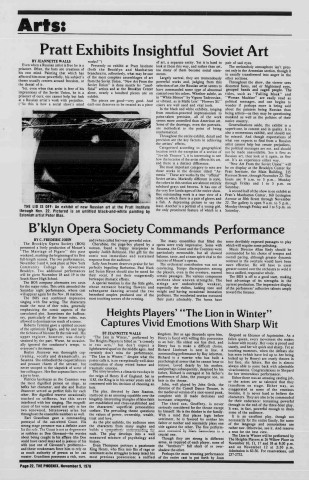
A r t s :Pratt Exhibits Insightful Soviet ArtBY JEANNETTE WALLSEven when a Russian artist is free he is a prisoner. Often, the bars are creations of his own mind. Painting that which has affected him most powerfully, his subject%u2019s theme usually centers around freedom, or the denial of it.Yet, even when that artist is free of his impressions of the Soviet Union, he is a prisoner of ours; one cannot help but look at a Russian artist%u2019s work with prejudice. (%u201c So this is how a social slave%u2019s mindworks?%u201d )Presently on exhibit at Pratt Institute (both the Brooklyn and Manhattan branches) is, collectively, what may be one of the most complete assemblages of art from the Soviet Union. %u201c New Art From the Soviet Union%u201d is done mostly by %u201c unofficial%u201d artists and at the Brooklyn Center alone, nearly a hundred pieces are on exhibit.The pieces are good%u2014very good. And each one deserves to be treated as a pieceof art, a separate entity. Yet it is hard to look at them this way, and rather than art, too many of them become social statements.Largely surreal, they are tremendously powerful works and, judging from this selection of art, the Russian artist seems to have commanded some type of abnormal control over his colors. Whether subtle, as in %u201cWhite Silence%u201d by Viguen Tadevosian, or vibrant, as in Malle Leis%u2019 %u201c Flowers XL%u201d colors are well used and vital tools.In the black and white exhibits, ranging from emotion-powered impressionism to pains-taken precision, all of the work seems more controlled than American art. Some of the drawings, even the portraits, are methodical to the point of being mathematical.Throughout the entire exhibit, detail and precision are the key factors in achieving the artists%u2019 effects.Categorized according to geographical location (with the exception of a section of \how the location of the artist effects his art, and there is a distinct difference.The most important category to note are those works in the division titled %u201c Armenia.%u201d These are works by the %u201cofficial%u201d Soviet artists. Markedly different in style, the colors in this section are almost entirely subdued grays and browns. It has one of the very few landscapes of the entire show. One outstanding work is a true view of a table on which there is a pair of gloves and a fish. A depressing picture to say the least. Another is a portrait of a young girl, the only prominent feature of which is apair of sad eyes.The melancholy atmosphere isn%u2019t present only in the Armenian section, though it is usually transformed into anger in the other sections.Throughout the show, the viewer sees distorted faces, sad or frightened eyes, grouped hands and caged people. The titles, such as %u2018%u2018Falling Mask%u201d and %u201c Woman Machine%u201d are easily read as political messages, and one begins to wonder if perhaps more is being said about the painters being Russian than being artists%u2014as they may be questioning mankind as well as the policies of their native country.Generalizations aside, the exhibit is a superb one, in content and in quality. It is also a momentous exhibit, and should not be missed. And though expectations of what one expects to find from a Russian artist cannot help but create prejudices, the political messages are not, and should not be made unavoidable. See it first as Russian art, then look at it again, as fine art. It%u2019s an experience either way.%u201c New Art From the Soviet Union%u201d will be on display at the Brooklyn Center for Pratt Institute, the Main Building, 215 Ryerson Street, through November 22. The hours are 9 a.m. to 5 p.m., Monday through Friday and 1 to 5 p.m. on Saturday.A second half of the show is on exhibit at Pratt%u2019s Manhattan Center, 160 Lexington Avenue at 30th Street through November 22. The gallery is open 9 a.m. to 5 p.m., Monday through Friday and 1 to 5 p.m. on Saturday.THE LID IS OFF: An exhibit of new Russian art at the Pratt Institutethrough Nov. 22. Pictured is an untitled black-and-white painting byEstonian artist Peter Ulas.B%u2019klyn Opera Society Commands PerformanceBY C. FREDERIC JOHNThe Brooklyn Opera Society (BOS) presented a lively production of Mozart%u2019s %u2018%u2018The Marriage of Figaro%u201d this past weekend, marking the beginning of its first full-length season. The two performances, November 3 and 4, took place at New York Community College in downtown Brooklyn. Two additional performances will be given November 18 and 19 in the South Shore High School.The BOS company alternates two casts for the major roles. This critic attended the Saturday night performance, whose cast will appear again for the Nov. 18 matinee.The BOS cast combined impressive singing with fine acting. The characters made the most of ther roles, generally emphasizing the comic aspects of the convoluted plot. Sometimes the buffoonery, particularly of the lesser roles, was allowed to dominate too much of a scene.Roberto Termini gave a spirited account of the optimistic Figaro, and by and large the richness of his tone fit the role well. His upper register, however, was clearly strained by the part. Worse, he occasionally ignored the conductor%u2019s tempo, to everyone%u2019s detriment.Roslyn Jhunever was thoroughly captivating, vocally and dramatically, as Susanna. She embodied the coquettishness and peasant charm of the servant, but never stooped to the slapstick of some of her colleagues. Her fine soprano lines were a joy to hear.Patricia lacobazzo as the Countess was the most dignified person on stage, as befits her character, and she and Roslyn Jhunever served as perfect foils for each other. Her dignified reserve occasionally touched on stiffness, but this never interfered with her singing. The magnificence of her voice soared not only in her two renowned, bittersweet arias but throughout the ensemble numbers as well.Earl Grandison gave a commanding portrayal of the out-witted Count. His strong stage presence was a definite assetT o * * o 1 o TV*o P /v iiM i i%u00abr *i a 4 o c / lo o o n o r o f o *v * * v %u2018 w' *%u201cor ruthless as Don Giovanni%u2014he worries about being caught in his affairs (the Don could have cared less) and is jealous of his wife (not one of Giovanni%u2019s problems)%u2014 and these weaknesses force him to rely on as much authority of person as he can muster. Grandison possesses a rich, sure,and (when called for) very powerful voice.Cherubino, the page-boy played by a woman, found a happy interpreter in spunky Judith Robinson. Her gift for the comic won immediate and sustained response from the audience.Sally Ann Swarm deserves praise for her perfectly beguiling Barbarina. Paul Huck and Susan Hayes should also be noted for their vocal, if not their exageratedly burlesque dramatic efforts.A special mention is due the little girls, whose entrance bearing flowers and subsequent dancing around the two betrothed couples produced one of the most touching scenes of the evening.The many ensembles that filled the opera were truly impressive. Some with Susanna, the Count and the Countess were particularly memorable, but all showed balance, taste, and a team spirit vital to the success of Mozart%u2019s operas.The orchestral contribution was not so convincing. Tempo discrepancies among the players, even in the overture, marred certain passages. The various component sections show uneven strengths. The strings are undoubtedly weakest, especially the violins, lacking tone and weight and having occasional intonation problems. The woodwind section executed their parts admirably. The horns havesome devilishly exposed passages to play which will require some polishing.Music Director Allan Endy should be commended for his choice of tempos and overall pacing, although greater dynamic contrast in the overture would have been more effective. He will have to exert greater control over the orchestra to weld it into a unified, responsive whole.The BOS is off to a good start, making best advantage of its strengths in the current production. The impressive display of the performers%u2019 collective talents amply reward the listener.Heights Players%u2019 %u201c The Lion in Winter%u2019%u2019 Captures Vivid Emotions With Sharp WitBY JEANNETTE WALLS%u201cThe Lion in Winter,%u201d performed by The Heights Players is billed as %u201ca comedy in two acts,%u201d but don%u2019t expect a lighthearted spoof on the middle ages. And certainly don%u2019t, miss the performance. %u201cThe Lion in Winter,%u201d despite what the poster calls it, is an exceptionally well-done combination of sharp witted humor and traumatic emotion.The story involves a climactic two days in the reign of Henry II of England. Set in 1183, the King is in his senior years and is concerned with his decision of choosing an heir.The play, directed by Jane Stanton, starts out as an amusing squabble over the kingship. Interesting triangles of false faith are established and cross-established and the characters%u2019 superficial personalities surface. The prevailing theme questions the values of power, ownership, wealth, trust and love.As the plot unfolds, the audience sees the characters from many angles andkiitl/Ic o citn*%u00ab*%u00ab4l*n4V4Mik*.U*%u00abi%u00bbtg >w*each. The play develops into a well measured mixture of psychology and history.Evan Thompson portrays a passionate King Henry, who flies into fits of rage or sentiment as he struggles to keep intact his most precious possession: a unifiedkingdom. But as age descends upon him, Henry is faced with willing this possession to an heir. His oldest son has died, and Henry has to make a difficult choice. Richard Lionheart is next in line. A commanding peformance by Ray Atherton, Richard is a warrior who has built a psychological armor that he cannot bear to remove. Loved dearly by his mother, and perhaps subsequently, despised by his father, Richard is outraged at his father%u2019s perference of John, the youngest son, as heir to the throne.John, well played by John Geils, the director of the Carroll Dance Theatre, is the medieval version of a snot-nosed punk, complete with ill made decisions and incessant wimpering.The third son, Geoffrey, is never seriously considered for the throne except by himself. He is the thinker in the family. With a mind that places logic before sentiment, he is favored by neither his father or mother and constantly plays one side against the other. The fine perform-------------------------------A - J t------ +%u25a0 M ------- O ____ I %u2022a n w v 1 / A vv .u tv u v j m a i v j a u i u u a u u ia acrucial one.Though they are strong in different areas, as required of each player, none of the %u201cbrothers%u2019%u201d fall short of or overshadow the other.Perhaps the most stunning performance of the entire cast is put forth by JoanShepard as Eleanor of Aquintaine. As a fallen queen, every movement she makes is done with royalty. Her voice is proud and stately, and her wit quick and sharp. Yet at touching moments, when the defeats she has seen (which have led up to her being locked up by Henry) are cruely thrown in her face, she falters. But she is almost always able to come back with admirable vivaciousness. Congratulations to Shepard for her tremendous performance.Either there was an amazing casting job, or the actors are so talented that they transform on stage. Either way, as exaggerated as some of the emotions become, it is never hard to believe the characters. They are also to be commended for their endurance: remaining powerful through to the end of the three-hour play. It was, in fact, powerful enough to drain some of the audience.It is an excellent play, though not necessarily for the entire family, for some of the language and connotations are rather raw. Otherwise, see it. And reserve a seat for the best view.The Lion in Winter will be performed by The Heights Players at 26 Willow Place on November 10, 11, 17 and 18 at 8:30 p.m. and on November 12 at 2:30 p.m. Admission is $3.50. For reservations, call 237-2752.Page 22, THE PHOENIX, November 9,1978


