


Page 737 - Demo
P. 737
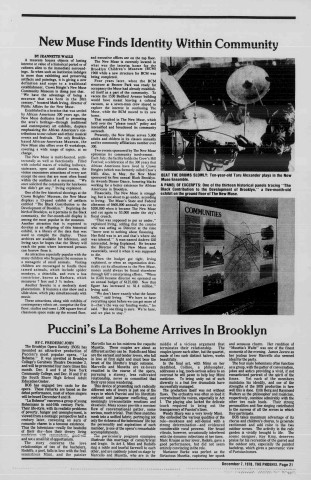
New Muse Finds Identity Within CommunityBY JEANNETTE WALLSA museum houses objects of lasting interest or value of a historical period or of cultures alien to the immediate surroundings. So when such an institution indulges in more than exhibiting and preserving artifacts and paintings, it is giving a new definition and scope to a traditional establishment. Crown Height%u2019s New Muse Community Museum is doing just that. %u201c We have the advantage of being a m useum that was born in the 20th century,%u201d boasted Mark Irving, director of Public Affairs for the New Muse.Established in a location that was settled by African Americans 300 years ago, the New Muse dedicates itself to promoting the area%u2019s heritage%u2014through traditional and contemporary art exhibits, displays emphasizing the African American%u2019s contributions to our culture and ethnic musical events and festivals. The only Brooklynbased African-American M useum, the New Muse also offers over 45 workshops, covering a wide range of topics, at no charge.The New Muse is multi-faceted, architecturally as well as functionally. Filled with colorful mazes of winding hallways, staircases, open and closed rooms, the visitor encounters attractions of every sort except the ones that are most often found within the confines of a museum. %u201c We once solicited the community for heirlooms but didn%u2019t get any,%u201d Irving explained.One of the few historical showings at the Crown Heights%u2019 Museum, the New Muse displays a 13-panel exhibit of artifacts entitled %u201c The Black Contribution to the Development of Brooklyn.%u201d Depicting the birth of Brooklyn, as it pertains to the black community, the five-month-old display is among the most popular in the museum. Another attraction that is expected to develop as an offspring of this historical exhibit, is a library of the data that was used to compile the display. These archives are available for reference, and Irving says he hopes that the library will reach the point where interested persons can borrow from it.An attraction especially popular with the many children who frequent the museum is a menagerie of small animals. Visiting children are encouraged to fondle these tam ed anim als, which include spider monkeys, a chinchilla, and even a boa constrictor, known as Barbara, which measures 7 feet and 3 V* inches.Another favorite is a modestly sized planetarium. It features a star show and a slide show, which play simultaneously with music.These attractions, along with exhibits of contemporary ethnic art, comprise the first floor; studios and some 1,500 square feet of classroom space make up the second floor,and executive offices are on the top floor.The New Muse is currently located in what was the interim home for the Brooklyn C hildren%u2019s M useum (BCM) 1968 while a new structure for BCM was being completed.Four years later, when the BCM structure at Brower Park was ready for occupancy the Muse had already established itself as a part of the community. To vacate the 1530 Bedford Avenue building would have meant leaving a cultural vacuum, so a seven-man crew stayed to explore the interest in continuing The Muse, while the BCM moved to its new home.That resulted in The New Muse, which held over the %u201c please touch%u201d policy and intensified and broadened its community outreach.Presently, the New Muse serves 5,000 adults and chldren in its classes annually and its community affiliations number over 300.Two events sponsored by The New Muse epitomize its community involvement. Each July, the facility holds the Crow%u2019s Hill Festival; a celebration of the 300 years that African Americans have lived in Crown Heights (which was formerly called Crow%u2019s Hill). Also, in May, the New Muse sponsored its first annual Black Brooklynite Awards Dinner Dance, honoring blacks working for a better existence for African Americans in Brooklyn.Financially, The New Muse is struggling, but is not about to go under, according to Irving. The Muse%u2019s State and Federal allotment of $600,000 annually was cut to $200,000 when it became The New Muse and cut again to $3,000 under the city%u2019s fiscal crunch.%u201c That was supposed to put us under,%u201d explained Irving, adding that the curator who was acting as Director at the time %u201c knew next to nothing about financing. Her field was in art and that%u2019s where she was talented.%u201d A man named Andrew Gill interceded, Irving Explained. He became the Director of The New Muse and, essentially, saved it when it was supposed to die.When the budget got tight, Irving explained, or when an organization drastically cut its allocations to the New Muse, money could always be found elsewhere through Gill%u2019s enterprising efforts. %u201c When he (Gill) became director we operated on an annual budget of $125,000. Now that figure has increased to $1.4 million,%u201d Irving said.%u201c We don't know exactly what the future holds,%u201d said Irving. %u201c We have to have everything spent before we can get more of it%u2014that%u2019s the way our funding works,%u201d he said. %u201c But one thing is sure. We%u2019re here, and we plan to stay.%u201dBEAT THE DRUMS SLOWLY: Ten-year-old Taru Alexander plays in the NewMuse Ensemble.A PANEL OF EXCERPTS: One of the thirteen historical panels tracing %u201c TheBlack Contribution to the Development of Brooklyn,%u201d a five-month-oldexhibit on the ground floor of The New Muse.Puccini%u2019s La Boheme Arrives In BrooklynBY C. FREDERIC JOHNThe Brooklyn Opera Society (BOS) hasmounted an attractive production ofPuccini%u2019s most popular opera, %u201c LaBoheme.%u201d It was unveiled at BrooklynCollege%u2019s Gershwin Theatre December 2,and will be presented four more times thismonth. Dec. 8 and 9 at New YorkCommunity College, and Dec. 16 and 17 atthe South Shore High School AdultEducation Center.BOS has engaged two casts for theopera. These remarks are based on thedebut performance, most of whose singerswill be heard December 8 and 16.%u201cLa Boheme%u201d concerns a group of youngBohemians in mid-19th century Paris.Their life-style, with its realistic problemsof poverty, hunger and unemployment, isviewed from a nostalgic perspective half acentury later, conveying an aura ofromantic charm to a tenuous existence.Thus the bohemians%u2014really the beatniksof their day%u2014face their dreary livingu %u2019 %u00ab + L %u00ab %u00ab ---------J . . M i\*%u00bb*%u25a0 I V , g W U ' W 111and not a small bit of opportunism.The story concerns the loverelationships of two of the bachelors,Rodolfo, a poet, falls in love with the frailseam stress Mimi, and the painterMarcello has as his mistress the coquetteMusetta. These couples are about asdifferent as they can be. Rodolfo and Mimiare the earnest and tender lovers, who fallin love at first sight and must bear thebrunt of the libretto%u2019s tragic outcome.Marcello and Musetta are ex-loversreunited in the course of the opera,pursuing a stormy, less cultivatedrelationship, never so committed thattheir eyes cease wandering.This device of presenting such radicallydifferent sets of lovers is just one of theways in which Puccini and his librettistscontrast and juxtapose conflicting, andseemingly irreconcilable emotions andsituations. Many scenes provide a constantflow of conversational patter, someserious, much trivial. That these snatchesmesh into a unified fabric, portraying notonly the richness of the bohemians%u2019 life butthe personality and aspirations of eachmember, is one of the opera%u2019s remarkableaccomplishments.Tiie particularly poignant examplesillustrate this marriage of comic/trivialand tragic. In Act 3, Mimi and Rodolfosing a noble and tearful farewell to eachother, and are suddenly joined on stage byMarcello and Musetta, who are in themiddle of a vicious argument thatterminates their relationship. Thecouples ignore each other, but the quartet,made of two such distinct halves, worksbeautifully.In the final act, with Mimi on herdeathbed, Colline, a philosopher,addresses a log, mock-serious adieu to anovercoat he will pawn to help buy Mimimedicine. To bring unity out of suchdiversity is a feat few dramatists havesuccessfully managed.The production itself was not withoutflaws. The orchestra was often so loud itoverwhelmed the voices, especially in ActI. The playing also lacked the delicatetouch required to bring out thetransparency of Puccini%u2019s lines.Wendy Sharp was a very lovely Mimi.She embodied the various qualities of therole%u2014meekness and self-denial with astrong determination%u2014and evidencedconsiderable vocal prowess. Her broadvibrato, however, occasionally interferedwith tne dynamic inflections of her lines.Marc Krause as her lover, Rodofo, gave agood performance, but did not seementirely convincing in the role.Marianne Burke was perfect as theflirtacious Musetta, capturing her spunkand sensuous charm. Her rendition of%u201cMusetta%u2019s Waltz%u201d was one of the finestmoments of the evening. James Javore asher jealous lover Marcello also seemedideal for the party.The four male bohemians often functionas a group, with the patter of conversation,jokes and antics providing a vivid, if notromanticized portrait of the spirit of thetim es. Yet each of the membersmaintains his identity, and one of thestrengths of the BOS production is howwell this is done. Erik Berg and RaymondWalters as the philosopher and musician,respectively, combine admirably with theother two male leads. Their strongpersonalities and fine singing contributedto the success of all the scenes in whichthey participate.BOS takes maximum advantage of itschorus and children%u2019s chorus, to generateexcitement and add color to the twooutdoor scenes. The activity in the cafegarden is vividly brought to life. Thescenic designer, Roy King, deservespraise for his recreation of the garret andthe outdoor sets, especially the paintedbackdrop, which gives a panoramic viewof Parisian homes.December 7,1978, THE PHOENIX, Page 21* * %u00bb .%u00bb


