


Page 359 - Demo
P. 359
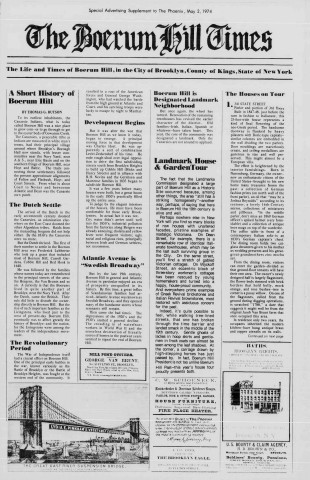
Special Advertising Supplement to The Phoenix, May 2, 1974The Life and Times of Boerum H ill, in the City of Brooklyn,County of K ings,State off Neu YorkA Short History ofBoeruHi HillBY THOMAS G. BUTSONTo its earliest inhabitants, the Canarsie Indians, what is today called Boerum Hill was a nice place to grow corn-or to go through to get to the oyster beds of Gowanus Creek. The Canarsies, a peaceable tribe as Indians are measured in white man%u2019s terms, had their principal village around where Brooklyn%u2019s Borough Hall now stands, with lesser communities near the Navy Yard, near A.& S., near Erie Basin and on the southern fringe of Boerum Hill, near Hoyt and Baltic. The trails connecting these settlements followed the present approximate alignments of Fulton and Flatbush, Hoyt, and Court Streets. From what is about Court to Nevins and betweenm Atlantic and Dean was the Canarsie corn patch.The Butch SettleThe arrival of the Dutch in the early seventeenth century doomed the Canarsies, as colonization elsewhere on the East Coast doomed the other Algonkian tribes. Raids from the marauding Iroquois did not help either. By the 1830%u2019s the Canarsies were no more.But the Dutch thrived. The first of their number to settle in the Boerum Hill area was Frederick Lubbertse who took up a grant that included most of Boerum Hill, Carroll Gardens, Cobble Hill and Red Hook in 1640.He was followed by the families whose names today are remembered in the principal streets of the area: the Bergens, the Van Brunts and so on. A curiosity is that the Boerums lived in quite another part of Brooklyn, near the Navy Yard. After the Dutch, came the British. Their rule did little to disturb the ownership directly in Boerum Hill. But the rise of such important families as the Livingstons, who lived just to the west of present-day Boerum Hill, eventually was to affect greatly the history of Brooklyn-and the nation, for the Livingstons were among the leaders of the independence movement.The BevoButionaryPeriodThe War of Independence itself had a crucial effect on Boerum Hill.One of the principal early battles in the war, known variously as the Rattle of Brooklyn or the Battle of Brooklyn Heights, was fought at the western end of the community. Itresulted in a rout of the American forces and General George Washington, who had watched the battle from the high ground at Atlantic and Court, and his surviving troops were lucky to escape by night to Manhattan.Development BeginsBut it was after the war that Boerum Hill as we know it today, began to emerge. A principal moving force in that development was Charles Hoyt. He was apparently a sort of combination Levitt-Zeckendorf of his time. He rode rough-shod over legal opposition to drive the first subdividing streets south from Brooklyn Heights to build up Cobble Hill (Hicks and Henry Streets) and in alliance with R.H. Nevins and the Gerritsen and Martense families in 1835 began to subdivide Boerum Hill.It was a few years before many houses were built, but a great boom in the early 1850%u2019s practically filled up the entire area.To judge by the elegant interiors of the houses, life must have been comfortable for those early Brooklynites. In actual fact it was not.City water didn't arrive until well into the 1850%u2019s; industrial pollution from the factories along Bergen was already annoying; cholera and yellow fever were frequent visitors; ugly racial and religious riots, principally between Irish and German settlers, not uncommon.Atlantic Avenue is%u201cSwedish Broadway\But by the late 19th century, Boerum Hill in general and Atlantic Avenue in particular enjoyed an era of prosperity unequalled in its history. By this time, a great influx of Scandanavian families had arrived--Atlantic Avenue was known as Swedish Broadway-and they opened many of the handsome stores whose remnants still remain.Then came the' bad times. The depressions of the 1920%u2019s and the 1930's started a general decline. The crowding in of waterfront workers in World War II and the senseless destruction of literally scores of homes in the postwar years seemed to signal the end of Boerum Hill.M IL L POND O Y STERS.GEORGE VAN BRUNT,No- 33 Fl.'LTON ST., BROOKLYN,Near I niton Terry, has on hand a lull supply of (tenuiiic Native Mill Pond Oysters, served up either Raw, Fried. Slewed (%u2022: Roasted.-V 13. Family ciders supplied at bhort notice.Boerum Hill isDesignated LandmarkNeighborhoodBut once again, the wheel has turned. Renovation of the remaining townhouses has revived the earlier character of the district. Old families-Irish, Italian, Spanish or whatever--have taken heart. This year, the core of the community was designated a landmark. Only the Canarsies are not around to applaud.Landmark House& GardenTourThe fact that the LandmarksCommission designated a largepart of Boerum Hill as a HistoricSite occurred because, amongother things, the area %u201cstill has astriking homogeneity%u2019%u2019-anotherway, perhaps, of saying that herein Boerum Hill the 19th century isalive and well.Perhaps nowhere else in NewYork will you find so many blocksof row houses with unalteredfacades, pristine examples ofnostalgic Victoriana. On DeanStreet, for example, there is aremarkable row of identical Italianate townhouses, which may bethe last such surviving group inthe City. On the same street,you%u2019ll find a stretch of gabledVictorian cottages. On WyckoffStreet, an eccentric block ofthree-story workmen's cottageshas been rescued by younghomemakers and turned into ahappy, house-proud community.And everywhere prime examplesof Greek Revival brickstones andItalian Revival brownstones, mostrestored with assiduous concernfor the past.Indeed, it%u2019s quite possible tofeel, while walking tree-linedstreets, that one has brokenthrough the time barrier andlanded smack in the middle of the19th century. Gentle ghosts ofladies in hoop skirts and gentlemen in frock coats can almost beseen among the leaf shadows. Atthe corner, a carriage drawn byhigh-stepping horses has justpassed by. In fact, Boerum HillPresident is not too unlike BoerumHiil Past-this year%u2019s house tourproudly presents both.C. W . S C H O 1 : N K( K.i:i M yrtle A venue, near F u lto n -t,Ui Ai.i n INSnichcrborkcr & Amman iUtthrnrr Ttauflrs.BOYNTON'S CALORIC FURN A CES, PARLOR, COOK & OFFICE STOVES, RANGES, Mill Wh o u s e : f u r n i t u r e ,In p n w m ! A lv i the (Tlrbram riB a ltim o re Im p ro ve d Brtsi- U u rn itiKF I R E P E A C E H E A T E R .tvk. [ K M c e rn r gj s t a f f s T h t? , P h o p n i /d r e H Q iv jn tU u ro i< -t wc m estpblisfimeor emt-rxuUJuiiui, of tries', adu's-risemenrsA /e ffv st-'n e y meet wni nt A P P R O V A L o f itu m o j ctiicriinufiohreadersCAfi'criaef rrrutrooj, Prepi. \\ \\ n w n r . N ,M l.I KIP : (H I l \\l|.| \\ s i s .B h < >i 'K 1 VN. N \\U.S. BOUNTY & CLAIM AGENCY,H. B. B R O W N & CO.,N lo n ta u u e S tr e e t, n o e r C o u rt, B R O O K L Y N .Soldiers' Bounty, Pensions,1%u2018 R r / i : m o n f : \\ . n . \\ < k i %u00bb a y . .v1%u2018 H f lH I ' l i t %u00ab I I I |.K t I m iP T F /'U ], A T T F N 'l ION v t H f'iR S of DCOEASI'D S O l.W L K * 0*Tic< %u2022 1 %u2022 f%u2019_ M ICur-rt,if .o' p


