


Page 460 - Demo
P. 460
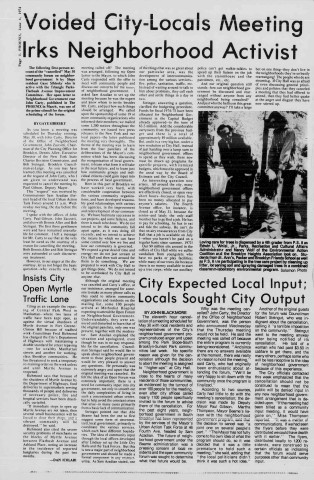
Page 4, PHOENIX, June 6, 1974 Voided City-Locals Meeting Irks Neighborhood ActivistThe following first-person account of the %u201ccancelled%u201d May 30community forum on neighborhood government is by Sloperesident Gaye Sibirsky who isactive with the Triangle ParksFlatbush Avenue ImprovementCommittee. Her open letter toNeighborhood Government czarJohn Carty, published in ThePHOENIX in March, was one ofthe prime stimuli for the originalscheduling of the forum.BY GAYE SIBIRSKYAs you know a meeting was scheduled for Thursday evening, May 30, with John Carty, Director of the Office of Neighborhood Government, John Zuccotti, Chairman of the City Planning Office for Brooklyn, Dennis Allee, Executive Director of the New York State Charter Revision Commission, and Bob Steingut, Brooklyn Councilman-at-Large. As you may have learned, this meeting was cancelled at the request of John Carty, who 1 am given to understand was requested to cancel the meeting by Paul Gibson, Deputy Mayor.This %u2018%u2018request1%u2019 was received by Commissioner Sam Azadian (former head of the local Urban Action Task Force) around 11 a.m. Wednesday morning, the day before the meeting.I spoke with the offices of John Carty, Paul Gibson, John Zuccotti, and also with Dennis Allee and Bob Steingut. The first three gentlemen were and have remained unavailable for comment. I left a message for Mr. Carty to sav that at the very least he owed us the courtesy of a reason for cancelling the meeting. Both Dennis Allee and Bob Steingut were astounded at such discourteous treatment.However, in our anger at the discourtesy, let us not forget the basic question -why exactly was theInsists City Open Myrtle Traffic LaneCiting as an example the repaving of Central Park West in Manhattan---where two lanes of traffic have been kept open, as against the virtual shutdown of Myrtle Avenue in Fort Greene/ Clinton Hill because of roadbed work--Councilman Fred Richmond has charged the City%u2019s Department of Highways with maintaining a double standard for street repaving -one for wealthy Manhattan streets and another for workingclass Brooklyn communities. Fie has threatened to seek a temporary restraining order on the work unless and until Myrtle Avenue is reopened.Richmond says that because of the shutdown of Myrtle Avenue by the Department of Highways, food deliveries to supermarkets serving thousands of people and deliveries of necessary police, fire and hospital services have been drastically curtailed.\Myrtle Avenue are not taken, then several small businessmen will beuvibrant community will bedestroyed,\Richmond also cited the severe security problems of merchants on the blocks of Myrtle Avenue between Flatbush Avenue and Ashland Place, noting an increase in the incidence of reported burglaries during the past two months.-DAN ICOLARImeeting called off? The meeting was arranged, following my Open Letter to the Mayor, to which John Carty responded with the offer to meet with community people and discuss our concerns for the iinuic of neighborhood government. 1 asked Sam Azadian to set up the meeting because he was the expert and knew whom to invite besides Mr. Carty, and just how such things should be arranged. We called upon the sponsorship of some 19 or more community organizations who informed their members; we mailed some 1,200 notices throughout the community; we issued two press releases to the New York and our local papers-the latter publicized the meeting very thoroughly. The theme of the meeting was to learn from the four panelists of the deliberations of the Mayor's committee which has been discussing the reorganization of local government, to learn what form it will take in the near future, and to learn just how community groups and individual citizens could gain input into the process of local government.Here in this part of Brooklyn we have worked very hard, with considerable cooperation between the various community organizations, and have developed reasonably good relationships with various city agencies, in the improvement and redevelopment of our community. We have had many successes in our projects, and some failures, and there is much to be done. We do not intend to let this community fall apart again, as it was doing till recently, and we intend to achieve the means by which we can have some control over how we live and how our community is governed. We expend a great deal of time and energy-we do not just scream at City Flail and then wait around for them to do something. We are prepared to work with City Hall to get things done. We do not intend to be overlooked by City Hall or anyone else.Although the original meeting was canceled and Carty%u2019s office, at our insistence, arranged for someone to make as many phone calls as they could to inform community organizations and residents on the mailing list, some 100 people arrived at Methodist Hospital expecting to attend the Open Forum on Neighborhood Government. Understandably, they were annoyed and disturbed to learn that of the original panelists, only one was present, together with the moderator. Sam Azadian explained the situation and apologized, even though he was in no way responsible for the cancellation. Councilman Steingut said he would like to speak about neighborhood government to those people present and would be very pleased to answer any questions. He personally was extremely angry and upset that the original meeting was canceled. He felt the idea of an Open Forum was extremely important; there is a need for community input into city government, not only to smooth out the daily complexities of living in such a concentrated urban center, but to help avoid the constant crises that arise-in many cases primarily from a basic lack of communication.Steingut pointed out that Abe Beame had been the one to first suggest some torm of decentralized, local government, primarily to coordinate the various services, which each have different boundaries. The idea of community input through the local offices developed after Lindsay set up the Little City Halls and the Task Forces. But this is now a major part of neighborhood government and should be made a formal component in any restructuring. As Sam Azadian stated, oneof the things that was so great about our particular area, was the development of intercommunication among the various servicesfire, police, sanitation, traffic, etc. Instead of waiting around to talk to him about problems, they call each other and settle things in a day or two.Steingut, answering a question, clarified the budgeting procedure. Funds for fiscal 1974/75 have been allocated for Neighborhood Government in the Capital Budget already approved-to the tune of S3.5 million. Add the considerable carryovers from the previous budget and there is a total of approximately $9 million available. But, and it is a very big but, under a new resolution at City Hall, instead of just handing over a lump sum to neighborhood government offices to spend as they wish, there now must be drawn up programs for specific projects, with itemized budgets, which must be approved in the usual way by the Board of Estimate and the City Council.An interesting question now arises. All around the city, many neighborhood government offices are effectively closed, or open very short hours--because there has been no money allocated to pay anyone%u2019s salaries. The Fourth Avenue office, for instance, is closed as of May 31, because the senior-and lately the only-staff member has to go find a job. He has to pay for schooling, he has to eat and ride the subway. He can%u2019t do that on airy reassurances from City Hall that a job is available on July l--when you haven%u2019t be paid on a regular basis since summer, 1973!Our $9 million sits around in the coffers of City Hall while we suffer vandalism from youngsters who have no parks or play facilities; while many of our trees die because there is no money available to start up a tree corps; while our auxiliarypolice can%u2019t get walkie-talkies to speed up their liaison on the job with the staionhouse and the patrolmen, etc., etc.And our original question still stands-how can neighborhood government be discussed and rearranged without anyone from any neighborhood being consulted? And just who the hell is on this great committee anyway? I%u2019ll take a largebet on one thing-they don%u2019t live in the neighborhoods they%u2019re so busily rearranging! The people who do are steaming. If City Hall was so afraid of even discussing general principles and policies that they canceled a meeting that they had offered to attend, then they had better quake at the anger and disgust they have now stirred up.Loving care for trees is dispensed by a 4th grader from P.S. 8 asEdwin L. W eisl, Jr.. Parks, Recreation and Cultural AffairsAdm inistrator and Nancy W olf of the Environmental ActionCoalition arxi the Brooklyn Heights Association look on. Students from St. Ann%u2019s, Packer andBrooklyn Friends School as wellas P.S. 8 ore participating in the tree care project by cleaning uplitter, loosening soil and spraying damaged trees In a combinedclassroom-laboratory environmental program. Solomon PhotoCity Expected Local Input; Locals Sought City O utputBY JOHN BLACKMOREThe eleventh hour cancellation of a meeting scheduled for May 30 with local residents and representatives of the City%u2019s neighborhood government program produced anger and upset among the Park Slope-South Brooklyn-Sunset Park communities last week. No specific reason was given for the cancellation although the decision to abort the meeting is assigned to %u201c higher-ups%u201d at City Hall.Neighborhood government is close to the hearts of many residents of those communities, as evidenced by the turnout of over 100 people for the meeting, even after city offices called nearly 1100 people specifically invited to the forum to advise them of the cancellation. For the past eight years, neighborhood government in Southk/V M n Wl wviMJfll %u2022 IVJHJ WVWI I IVz|i/l U W IIIVUby the services of the Mayor%u2019s Urban Action Task Force at 46 Fourth Ave. headed by Sam Azadian. The future of neighborhood government under the Beame administration was a pressing concern of local residents and the open community forum was sought to determine what that future would be.Why was the meeting cancelled? John Carty, the Director of the Office of Neighborhood Government, was the person who announced Wednesday that the Thursday meeting would not be held. He said the meeting was called off because the entire program is currently bei ng reconsidered, %u2018 %u2018 And si nee there are no answers available at the moment, there was really no reason to hold the meeting,%u201d said Carty, who had originally been enthusiastic about attending the forum, %u201c We%u2019ll be very happy to sit down with the community once the program is finalized.%u201dAccording to two sources, Carty had little to do with the meeting%u2019s cancellation; the decision was made by Deputy Mayor Paul Gibson. Martha Thompson, Mayor Beame%u2019s liaison with the neighborhood government program, said that the decision to cancel was %u201c a joint one on several people%u2019s part.%u201d %u201c The Mayor has not fully come to his own idea of what the program should do, so it was decided that it was a little premature to hold such a meeting,%u201d she said, adding that %u201c the local politicians d id n %u2019t think it was such a hot idea.%u201dAnother of the original guests for the forum was Councilman Robert Steingut, who was indignant about the cancellation, calling it %u201c a terrible imposition on the community.%u201d Steingut went to the meeting anyway after being notified of its cancellation. He told of a woman who had paid $3.50 in cabfare to get there, and the many others, perhaps some who will be less receptive to the idea of neighborhood government because of this experience.The City officials contacted this week emphasized that the cancellation should not be construed to mean that the public will be denied input in any new neighborhood government arrangement that is decided upon. %u201c If the meeting had been billed as a community input meeting, it would have gone on,%u201d Miss Thompson reportou. %u201c It was a matter of communications. If we had seen the flyers before they were distri buted we could have dealth with it earlier.%u201d The flyers, distributed locally to 1200 residents, were construed by certain officials as indicating that the forum would serve purposes other than community input.V5.3K.A ! \\ H W** WJA/W W MtyWVfc %u2022-'i. t %u2019 V V WWWtMTi . i U!f '5 r u it t w j n h i n&r-tk it '* t: k ;%u00abu .umitii**


