


Page 500 - Demo
P. 500
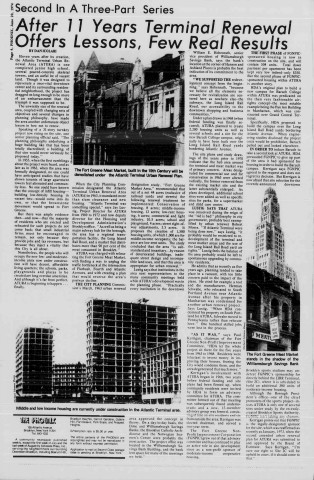
Page 4, PHOENIX, Jane 20, 1974 Second In A Three-Part SeriesAfter lOffersBYDANICOLARIEleven years after its creation, the Atlantic Terminal Urban Renewal Area (ATURA) is one completed junior high school, several poured-concrete skeletal towers, and an awful lot of vacant land. Though it was designed to rejuvenate a once-vital downtown center and its surrounding residential neighborhood, the project has dragged on long enough to be more of an embarrassment than the triumph it was supposed to be.The unwieldy size of the renewal area, coupled with changing sets of objectives and several changes in planning philosophy, have made the area another unfortunate object lesson in how not to renew.Speaking of a 31-story turnkey project now rising on the site, one senior planning official said, \planning philosophy underlying a %u00a3huge building like that has been %u00a7 totally discredited; a building of J that size would never seriously be 1/1 proposed today.\JIn 1955, when the first rumblings s about the project were heard, and as late as in 1963, when the area was formally designated, no one could have anticipated studies that have shown tenants of large apartment towers feel alienated and community-less. No one could have known that the concept of infill housingbuilding low-density housing in vacant lots%u2014would come into its own, or that the brownstone movement would spread to Fort Greene.But there was ample evidence then%u2014and now%u2014that the majority of residents who are evicted and relocated for such projects do not come back; that small industrial firms .must be encouraged to remain, not only because they provide jobs and tax revenues, but because they inject a vitality that this City is all about.Nonetheless, the people who will occupy the new low- and moderateincome units now under construction will have decent, affordable living quarters; the schools, parks, playgrounds and plazas to be created arc long overdue amenities. And although it's far from perfect,A TURA is beginning to happen . . . finally,1 YearsLessons,Terminal RenewalFew Real ResultsThe Fort Greene Meat Market, built in the 19th Century will bedemolished under the Atlantic Terminal Urban Renewal Plan.When the City Planning Commission designated the Atlantic Terminal Urban Renewal Area (ATURA) in 1963, it mandated more than slum clearance and new housing. %u201c Atlantic Terminal was something special,\tig, Project Director for ATURA from 1969 to 1972 and now deputy director for the Housing and Development Adm inistration%u2019s Brooklyn office. %u201c As well as being a major subway hub for the borough, the area has a regional transportation facility, the Long Island Rail Road, and a market that distributes more than 90 per cent of the meat consumed in Brooklyn.\ATURA was charged with relocating the Fort Greene Meat Market, with finding a way to unplug the traffic bottleneck at the intersection of Flatbush, Fourth and Atlantic Avenues, and with creating a plan that would reverse the area%u2019s postwar decline.THE CITY PLANNING Commission%u2019s March, 1963 urban renewaldesignation study, \Market Area,%u201d recommended that out of a net 44 acres (exclusive of railroad yards and streets) the following renewal treatment be implemented: Conservation of housing, 8 acres; middle-income housing, 12 acres; low-rent housing, 6 acres; commercial and light industry, 10.5 acres; school and playground, 4 acres; street right-ofway adjustments, 3.5 acres. It proposes the creation of 1,580 housing units, of which 1,000 are for middle-income occupants; the balance are low-rent units. The study concluded that the area \standard and insanitary...by reason of deteriorated buildings, inadequate street design and incompatible land uses, and that this area is appropriate for urban renewal.%u201d Lustig says that institutions in the area sent representatives to the many community meetings held while ATURA%u2019s development was in the planning phase. %u201c Practically every institution in the downtownWilliam E. Hohenrath, senior vice president of Williamsburgh Savings Bank, says the bank%u2019s location at the corner of Hanson and Ashland Places is probably the best indication of its commitment to the area.%u201c WE SUPPORTED THE redevelopment concept from the beginning,%u201d says Hohenrath, %u201c because we believe all the elements necessary for revitalization are centered here as nowhere else-the subways, the Long Island Rail Road, our accessibility to the downtown shopping and business communities.%u201dUnder a plan drawn in 1968 (when federal funding was finally secured), ATURA planned to create 2,200 housing units as well as several schools and a site for the new Baruch College campus, originally to have been built over the Long Island Rail Road yards bordering Atlantic Avenue.The site plans and study drawings of the years prior to 1970 indicate that the hub area around the terminal and meat market was of primary concern. Areas designated for commercial use and for conservation in 1963 were altered radically, the former removed from the existing market site and the latter substantially enlarged. As plans developed, additional school sites were added as well as specific sites for parks, for a supermarket and child care center.LUSTIG SAYS THAT ATURA was conceived during the reign of the %u201cold is bad\government, probably best exemplified by urban renewer Robert Moses. %u201c If Atlantic Terminal were being done now,%u201d says Lustig, %u201c it probably would be restricted to redevelopment of the terminal and meat market areas and the use of the Long Island Rail Road yard air rights.%u201d Lustig feels the balance of the area probably would be left to spontaneous upgrading by community residents.He admits that as recently as five years ago, planning tended to take place in a vacuum, with too little concern paid to the impact of the plans. He cited for example a tool and die manufacturer, Herman Schwabe, who relocated to South Portland Avenue near Atlantic Avenue after his property in M anhattan was condemned for another urban renewal project. Says Lustig, %u201c When HDA condemned his property on South Portland for ATURA, Schwabe moved to Pennsylvania rather than relocate here.%u201d One hundred skilled jobs ] were lost in the process. STHE FIRST PHASE of FGNPICsponsored housing is now in construction on the site, and will contain 504 units. Total down payment per apartment has been kept very low indeed-only $350. But the second phase of FGNPICsponsored housing within ATURA is another story.HDA%u2019s original plan to build a new campus for Baruch College within ATURA was predicated on the then very fashionable airrights concept-the most notable example being the Pan Am Building in Manhattan, which was constructed over Grand Central Terminal.Specifically, HDA proposed to build the campus over the Long Island Rail Road yards bordering Atlantic Avenue. When engineering studies disclosed the project costs would be prohibitive, Baruch pulled out and looked elsewhere.IN ORDER TO induce Baruch to take a second look at ATURA, HDA persuaded FGNPIC to give up part of the area it had sponsored for housing in order to build the Baruch campus. Kerrigan says FGNPIC agreed to the request and does not regret its decision. But Kerrigan is now afraid that site selection for the recently-announced downtownMiddle and low income housing are currently under construction in the Atlantic Terminal area.%u201c AS IT W AS,%u201d says Paul Kerrigan, chairman of the Fort Greene Non-Profit Improvement Committee, %u201c HDA let the whole project sit there for the five years from 1963 to 1968. Residents were reluctant to invest money in improving their houses, fearing the City would condemn them, and the area degenerated that much more.%u201d Kerrigan%u2019s involvement with ATURA began in 1966, two years before federal funding and site plans had been firmed up, when community residents were invited by HDA to form an advisory committee for ATURA. The committee formed out of that meeting was subsequently found undemocratic and a new, 15-member advisory group was formed, consistmo 0f n inp nrt.cttp r^%u00bbcir1^ntc artH civThe Fort Greene Meat Marketstands in the shadow of theWilliamsburgh Savings BankBrooklyn sports stadium may undercut FGNPIC%u2019s sponsorship for directly behind the LIRR Terminal, (Site 2 0 , where it is scheduled to build an additional 380 units of moderate-income housing.Although the Borough President's office--one of the chief promoters of the sports project-in- .sists ATURA is only one of several sites under study by the recentlycreated Brooklyn Sports Authority,m L r.M D ir lrl*l r. o rnr wimj155 Atlantic Avenue Brooklyn, New York 11201 Tel. 643-1032A community newspaper published weekly, except the first week of July and the last week of August by Advocate Press, Inc., serving the neighborhhods surrounding Downtown Brooklyn, including Boerum Hill,Brooklyn Heights, Carroll Gardens, Cobble Hill, Foil Greene, Park Slope, and Prospect Heights.Subscription rate is $5.00 pr year.The entire contents of the PHOENIX are copyrighted and may not be reproduced in any form without express permission.Application to mail at Second Class postage rates is pending at Brooklyn, New Yorkarea approved the concept in theory. On a day-to-day basis, the Dime and Williamsburgh Savings Banks, the Brooklyn Catholic Archdiocese and the Norwegian Seamen's Center were probably the most active. The project office was located in the Williamsburgh Savings Bank Building, and the bank lent space for many of the meetings we held.%u201dtrom outside the area; Kerrigan was elected chairman, and served a two-year term.The Fort Greene NonProfit Improvement Corporation (FGNPIC) grew out of that advisory eommitee and has continued to play an active role in site development since as a non-profit sponsor of moderate-income cooperative housing.Kerrigan points out that FGNPIC is the legally-designated sponsor for the site, which was reaffirmed as recently as January. 1973, when the second amended urban renewal plan for ATURA was submitted to and approved by the Board of Estimate. Says Kerrigan, %u201c I%u2019m sure our right to Site 2C will be upheld in court, if it should come to that.%u201d


