


Page 163 - Demo
P. 163
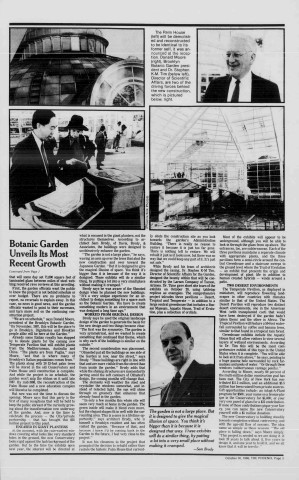
The Palm H ouse(left) w ill be dem olished and reconstructedto be identical to itsform er self, it was anflou n ced at ihG rGCGp*tion. Donald M oore(right), BrooklynBotanic Garden president and Dr. StephenK-M. Tim (below left),Director of ScientificAffairs, are tw o of thedriving forces behindthe new construction,which is picturedbelow, right.Botanic GardenUnveils Its MostRecent GrowthContinued from Page Ithat will some day set 71,000 square feet oflaminated glass between miles of steel webbing received rave reviews at this unveiling.First, the garden officials want the publicto know the project is not behind schedule orover budget. There are no problems toreport, no reversals to explain away. In thiscase, no news is good news, and the gardenofficials wanted to point to their successes,and turn more soil on the continuing construction project.%u201cWe are on schedule,%u201d says Donald Moore,president of the Brooklyn Botanic Garden.%u201cBy November, 1987, this will be the place togo in Brooklyn. Dignitaries and Brooklynpeople alike will be here at the Garden.%u201dAlready some Italian royalty has stoppedby to donate plants for the coming newTemperate Pavilion that will exhibit plantsfrom the Mediterranean, Australia andChina. %u201cThe plants are from Puglia,%u201d saysMoore, %u201cand that is where many ofBrooklyn%u2019s Italian populations comes from.%u201dThe plants along with 20 32-foot palm treeswill be stored in the old Conservatory andPalm House until construction is complete.And while the project is on schedule, thegarden won%u2019t snip the ribbon on it until late1987. By mid-1988, the reconstruction of thePalm House and a new education complexwill likewise be completed.But now was not the time to discuss the opening. Moore says that this party is the first of many receptions that will be held to keep the public abreast of the curiosity growing about the transformation now underway at the garden. And, now is the time to celebrate the process %u2014 the City/private partnership %u2014 that has brought this $25 million project to this point.ENCASED IN GIANT PLANTERSAt tiie inomeiit, wii.ii tiie rain-wasned windows covering what looks like very standard holes in the ground, the new Conservatory looks rigid against the lush background of the garden. But by the time the exhibits open next year, the interest will be directed atwhat is encased in the giant planters, not thestructures themselves. According to architect Sam Brody, of Davis, Brody, &Associates, the buildings were designed tounobtrusively enhance the garden.%u201cThe garden is not a large place,%u201d he says,waving an arm up over the trees that abut thenew construction and over toward theJapanese Garden. %u201cBut it is designed to givethe magical illusion of space. You think it%u2019sbigger than it is because of the way it isdesigned. These exhibits will do a similarthing, by putting a lot into a very small placewithout making it cramped.%u201dBrody says he was aware of the Olmsteddesign when he planned the new buildings.%u201cIt%u2019s a very unique experience for an architect to design something for a space suchas the Botanic Garden. You have to createsomething modern in an environment thatwas designed a long time ago.%u201dWORKED FROM ORIGINAL DESIGNBrody says he used the original landscapedesign of the garden to generate the basis forthe new design and two things became clear.%u201cThe first was the symmetry. The garden isvery symmetrical, and we wanted to createsomething that continued that theme, whichis why each of the buildings is similar on theoutside.%u201dThe second consideration was placement.%u201cOlmested put all the buildings on one side ofthe Garden in row, near the street,%u201d saysBrody. %u201cThese buildings are right in line withthat and are more visible from the street thanfrom inside the garden.%u201d Brody adds thatwhile the shining structures are momentarilyjarring amid the soft contours of Olmsted%u2019sdesign, the coming months will change that.The elements will weather the steel andcrystalize the windows somewhat, and instead of relected light, the sun will shinethrough on greenery that enhances thatalready found in the garden.%u201cIn only a few months this whole site will seem very much at home in the garden. The green inside will make it blend even more, but the elegant shapes fit in well with the surrounding area. This is a once in a lifetime opportunity,%u201d says architect Brody, who is himself a Brooklyn resident and has often visited the garden. %u201cBecause of that, andbecause I knew I'u be c o in in g b a c k io iiieGarden in the future, I feel very close to the project.%u201dIt was his closeness to the project that prompted the decision to rebuild rather than restore the historic Palm House that currently abuts the construction site as you looktowards the garden%u2019s AdministrationBuilding. %u201cThere is really no reason torestore it because it is just too far gone.There is nothing left to restore. We willrebuilt it just as it looks now, but there was noway that we could keep any part of it. It%u2019s justnot safe.%u201dWhile Brody and his team of architectsdesigned the casing, Dr. Stephen K-M Tim,Director of Scientific Affairs for the Garden,designed the bounty within that will be constructed by the Larson Company of Tucson,Arizona. Dr. Time gave short site tours of theexhibits on October 20, using tabletopreplicas as examples. The comprehensiveproject inlcudes three pavilions %u2014 Desert,Tropical and Temperate %u2014 in addition to alarge central greenhouse that includes a Bonsai Museum, Aquatic House, Trail of Evolution, plus a collection of orchids.The garden is not a large place. Butit is designed to give the magicalillusion of space. You think it'sbigger than it is because it isdesigned that way. These exhibitswill do a similar thing, by puttinga lot into a very small place withoutmaking it cramped.%u2014 S a m B ro d yMost of the exhibits will appear to beunderground, although you will be able tolook in through the glass from up above. Theentrances, too, are subterranean. Each of thethree pavilions maintains a separate climatewith appropriate plants, and the threepavilions form a semi-circle around the central Greenhouse and a staircase sweeps tothe ground level where the Trail of Evolution%u2014 an exhibit that presents the origin anddevelopment of plant life in addition tohuman created hybrids %u2014 winds around apatio.TWO DESERT ENVIRONMENTSThe Temperate Pavilion, as displayed inminiature, will reproduce flowering landscapes in other countries with climatessimilar to that of the United States. TheDesert Pavilion will reproduce two distinctdesert environments, one in the AmericanWest (with transplanted cacti that wouldhave been destroyed if the garden hadn%u2019ttaken them) and the other in Africa. TheTropical Pavilion will feature a 50-foot waterfall surrounded by coffee and banana trees,similar to that found in a tropical rain forest.Greenhouse exhibits include the AquaticHouse that will allow visitors to view severallayers of wetland environments. Accordingto Dr. Tim this will be the most comprehensive exhibit of this type in the UnitedStates when it is complete. %u201cYou will be ableto look at it from above,%u201d he says, pointing toa huge gaping hole surrounded by rock formations and pools of water. %u201cOr through thesewindows (subterranean vantage points).%u201dAccording to Moore, nearly 80 percent of the multi-million dollar construction goal has been met. The City of New York has contributed $11.5 million, and an additional $5.5 million has been raised from private sources. Gift opportunities include: an Adopt-A-Plant program for $500; your name on a bronze plaque in the Conservatory for $5,000; or your very own panel of glass for a $25 contribution. If none of those contributions pique your fancy, you can name the new Conservatory yourself with a $5 million donation.The new Conservatory is building steadily towards completion without controversy, and with the age-old flow of seasons. The idea came as simolv as those seasons. %u201cThe old place is falling down,%u201d says Moore simply. %u201cThis project is needed so we are doing it. It took 20 years to talk about it, five years to design it, and one year to build it, and we all know that it will be terrific.%u201dO cto ber 30, 1986, TH E P H O E N IX , Page 3


