


Page 258 - Demo
P. 258
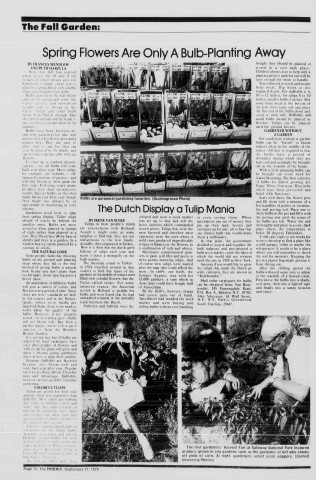
The Fall Garden:Spring Flowers Are Only A Bulb-Planting AwayW MBulbs are perennial gardening favorites. (Occhiogrosso Photo)BY FRANCES MENDLOWAND RUTH HARZULANow that fall h a s s ta rte d wmiei is not far off and if the thoutiln ot winter always gets you depressed, it might d icer you to plan for a spring filled with colorful tulips and fragrant hyacinths.Bulbs plained in the fall bloom carle in the spring and some like winter aconite and snowdrops actually si art 10 bloom in late winter. I'ulips and other bulbs bloom fr ni March through May after which annuals w ill be ready to take over for a colorful show in the summer.Bulbs have been favorites not onh with gardeners but also with anyone with a few flow er pots and a window box. They arc easy to plant, easy to care for. they can exen be plained in the shade, and can provide a spring table with cut flow ers.To clear up a common misconception -- not all bulbs will come back year after year. Most tulips, for example, arc hybrids -- offspring of a mixture of species --and will onlv bloom at their peak the first year. Following years might produce less than satisfactory results. Species bulbs, on the other hand, bloom year after year though they might not always be as spectacular or interesting in color scheme.Gardeners need little to plan their spring display. Taller tulips should of course be behind the smaller ones. Bulbs are most attractive when planted in clumps of eight rather than planted in a row. They'll look best a1*the base of shrubs and trees in a garden. In a window box ivy can be planted for a contrast in colors.THE NATURAL LOOKSome people claim that throwing bulbs on the ground and planting them where they fall is the best method of giving bulbs a natural look. In any case don't plant them too far apart, closer spacing gives a better show.An assortment of different bulbs will give a variety of colors, and flowers over a period of time. Since there arc strict standards set both in this country and in the Netherlands. where most bulbs arc imported from, there is no need to worry about the quality of the bulbs. However, if not properly stored -- in too warm a spot -- bulbs will not bloom well. Buy from a garden supply center with a quick turnover or from the Brooklyn Botanic Garden.It's getting late but if bulbs are ordered by mail catalogues have color photographs of flowers and tell how tall the plant will grow and when it blooms giving gardeners clues on how to plan their garden.Fragrant daffodils are favorites because they bloom well and come back year after year. Popular varieties are King Alfred. Cheerfulness and Advantage. Daffodils, however, are not good for container gardening.COLORFUL TULIPS'lulips are grown for their color and are often less expensive than daffodils. Most tulips are hvbrids hat come in brilliant colors and some that arc multi-colored or fringed. II gardeners want tulips hat return year after vear buy species bulbs, hvbrids will have to be replaced after a vear.T h e b e s 1 types for small yards or cotrainers are the Single F.arlv, triumph, t Hvbrids. Sc .diet bulbs that grow in later winter . r earb- spring arc veilovv Ft am it%u00a9 or Winict Aconite, white S' at %u2022 : Bethlehem, Se ilia or Forest Hya tmlt and pastel, pins or blue Graft . T. acmih.As soon as bulbs have beenThe first gardeners' Harvest Fair at Gateway National Park featuredproduce grown in city gardens such as the gardener at left who showsoff yield of corn, fit right, gardeners select prize peppers. (CornellUniversity Photos)bought they should be planted or stored in a cool dark place. Children always love to help with a planting project and this one will be easy enough for them to handle.You will need a trowel and soomc bone meal. Dig holes to the required depth. For daffodils it is 10 to 12 inches, for tulips 8 to 10 inches: smaller bulbs 3 inches. Mix some bone meal at the bottom of the hole with some soil and place the flat end of the bulbs down and cover it with soil. Daffodils and small bulbs should be planted in October. Tulips can be planted until the ground freezes. GARDENER WITHOUTA GARDENFor gardeners without a garden bulbs can be %u201c forced%u201d to bloom indoors often in the middle of the winter. All that is required is that the bulbs have a period of dormancy during which they are kept cool and gradually be brought out in the warmth of the house.With a little planning bulbs can be brought out every week for indoor blooming. The best varieties of bulbs for indoor growing are Paper White Narcissus. Hyacinths which have been prc-cooled and Soleil d'Or Narcissus.Start with short, flat flower pots and fill them with a mixture of a few handfuls of perlite or vermicuIite and potting soil. Place one to three bulbs in the pot and fill it with the potting mix until the noses of the bulbs arc left. Water the soil thoroughly and place in a cool, dark place where the temperature is below 50 degrees Fahrenheit.I' will take eight to ten weeks for roots to develop so find a place like a cold garage, cellar or maybe the refrigerator. It needs to be a place where you will remember to check the soil for moisture. Keeping the pot in a plastic bag might prevent it from drying out.After the chilling period the bulbs will need some time to adjust to the warmth of a heated room. First move the bulbs into a shady, cool area, then into a lighted spot and finally into a sunny location and enjoy.The Dutch Display a Tulip ManiaBY IRENE VAN SLYKETulips in most people%u2019s minds are synonymous with Holland though it might come as some surprise to find that they are not indigenous to the low lands. Actually, they originated in Turkey.How is it then that the dutch grow billions of tulips each year and seem to have a monopoly on the bulb market.The Austrian consul to Turkey in 1554 travelled around in that country to find that many of the gardens in the middle of winter were filled with colorful flowers that the Turks called tulips. For some unknown reason, the Austrian settled in Holland to peddle his bulbs and soon found that he had unleashed a mania in the unusally staid business-like Dutch.Varieties and hybrids were developed and soon a stock market was set up to buy and sell the latest varieties which commanded record prices. Tulips that were the most favored and therefore most expensive were the ones where a mild virus produced unpredictable stripes or flames on the flowers, in a combination of reds and whites.Merchants commissioned painters to paint still lifes and poets to write poems honoring lulips. And of course new tulips were named after the man who could afford the most. In 1609, one bulb, the Semper August, was sold for 13,000 guilders, a sum which in those days could have bought half of Amsterdam.By the 1630's, however, things had gotten quite out of hand. Speculators had invaded the stock market and were buying and selling bulbs without ever handlingor even seeing them. When speculators ran out of money they put up their land, horses and carriages up for sale, all to buy that one elusive bulb that would make them a millionaire.At that point, the government decided to step in and regulate the bulb industry and precipitated a bulb stock market crash the likes of which the world did not witness until the one in 1929 in New York.Anyway if you would like to grow the lulips that made the Dutch go wild, currently they are known as %u201c Rembrandts.%u201dMail order catalogues for bulbs can be obtained from: Van Bourgondie, 245 Farmingdale Road. P.O. Box A, Babylon N.Y. 10702; John Schecpcrs, 63 Wall Street, N.Y. N.Y. Park%u2019s Greenwood, South Carolina, 29647.


