


Page 300 - Demo
P. 300
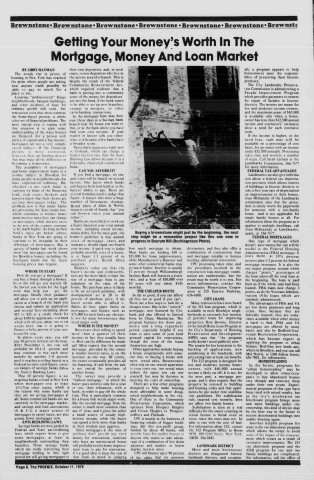
Brow nstone %u00ae Brownstome %u2022 Browns tome %u2022 Brownstone %u2022 Brow nstone %u2022 Brow nstone %u2022 BrownstcGettina Your Money%u2019s Worth In TheMortgage, Money And Loan MarketBY LIBBY HAYMANThe sieady rise in prices of housing in New York has reached ihe poini where people arc asking how anyone could possibly be able to pay so much for a place io live.Locating \neighborhoods, bargain buildings, and other incidents of hope for ordinary people still exist, but renovation costs that otten confront the homc-buver present a whole other set of financial problems. The most crucial step to coping with this situation is to gain some understanding of the ways houses arc financed. For a person with plenty of capital and a big income, mortgages arc not a very complicated subject. If the financial picture is more restricted, however, there arc funding devices that may make all the difference in becoming a homeowner.The availability of mortgages and home improvement loans is a stormy subject in Brooklyn for many people in neighborhoods that have experienced redlining. But whether or not each bank is carrying its share of the financing load, real estate brokers and lawyers report that their clients arc gening mortgages today. The problem now is that many banks arc protesting the State usury law, which continues to restrict maximum interest rates they can charge on mortgages, while interest rates in the rest of the country continue to be much higher. As long as New York's rates arc below others, banks in New York arc going to continue to be irregular in their offerings of mortgages. But a survey of banks last week shows show that mortgages can be found for Brooklyn homes, including the big-ftgurc funds that the latest housing prices may require.WHERE TO STARTHow do you get a mortgage? If you buy a house through a broker, he or she will get you started. Or the lawyer you retain for the legal work may help you get the mortgage. Ideally, their guidance will allow you to pick up an application at a branch of the bank you choose and submit an application and several fccs-including about S15 to $25 or a credit check for about $100 for appraisals--to a bank which will tell you, about two to six w'ceks later, that it is going to finance a hefty portion of your new house for you.In almost every case, you will pay 10 percent interest on the loan. After November 1, the cost will probably be 10-1/4 percent and may continue to rise each three months bv another 1/4 percent until it reaches a ceiling based on a Federal security-yield figure, (interest ranges of savings banks follow the State%u2019s Banking Law).That 10 percent figure, is not inspiring banks to lend in New York when mortgages cost at least 31%u2018/j%in other states, which is the reason why some banks say they are not giving mortgages at all. Some commercial banks are not currently in the mortgage market, and savings and loan associations (S & L%u2019s) a major source of mortgages in easier times, are also giving fewer mortgages now.ANTI-REDLINING LAWSSavings banks are now guided by Federal and State anti-redlining laws which reauire them to pive some mortgages, at least in neighborhoods surrounding their branches. Those savings banks which are really restricting their mortgage lending in this tight period are still giving mortgages totheir own depositors, and, in most cases, to non-depositors who live in the service area of a branch. This is largely the result of the federal Community Reinvestment Act, which required evidence that a bank is putting into a community some of the money the depositors put into the bank, if the bank wants to be able to set up new branches, engage in mergers, or other extra-banking transactions.So the mortgage hunt may best start these days at a Savings bank branch near the house you want to buy. or at the bank where you have had your own account. If your realtor or lawyer tells you otherwise, it is because a few banks have a broader scope.Particularly aggressive right now is Citibank, which can charge a higher interest rate than the State Banking Law allows because it is a federally chartered commercial bank.CAN YOU AFFORD IT?If you find a mortgage, its size and terms will be based on several factors. One factor which banks and buyers both look hard at is the buyers%u2019 ability to pay. There arc several formulas used to judge that figure. A lawyer who docs a huge number of brownstone closings, Bcrnd Allen of Allen & Norris, suggests a rule of thumb, that %u201c you can borrow twice your annual salary.%u201dBanks are more likely to work out a figure based on vour total annual income, including rental income, minus debts. For the most part, the lender's guideline is that annual costs of mortgage, taxes and insurance, should equal one-fourth your income. A quick way to judge probable monthly costs of a house, is to figure 1.1 percent of its purchase price, Bcrnd Allen suggests.Bankers today say that the buyer's income and creditworthiness are far more likely to limit the size of a mortgage than is any judgment on the value of the house. The purchase price is likely to be an accepted guideline, with downpayment set at 20 to 40 percent of purchase price, if the buyer seems able to afford it. Banks do have upper limits on mortgages, and figures such as $75,000 for such limits arc obviously low for many brownstoncs that need major work.WHERE IS THE MONEY?Buyers arc often willing to spend more than a quarter of their income; in fact they usually have to. How%u2019 can the difference be made up? Allen reports that the second mortgage, provided by the owner at market interest rates, is on the increase, as one way. Of course, the owner occasionally provides all the financing, if cash from the sale is not crucial for purchase of another house.The owner may provide a %u201c balloon mortgage,%u201d in which the buyer pays interest only for a year or two, then refinances, with a bank, in order to pay off the whole loan. This is particularly common for a house that needs major work. But the second mortgage from the owner is much more common than any of nese, and it gives the seller a small source of steady highinterest income, while the buyer can spend a little more than banks in their wisdom may approve.Since mortgages at the time ofnurrhacn Hnn%u2019t nrnviHp anv OYtramoney for renovations, someone who buys an unrenovated house will probably need a home improvement loan to pay for renovation. It%u2019s a good idea to keep the cost of that loan in mind in judgingBuying a brownstone might just be the beginning, the next step might be a renovation project like this one now in progress in Boerum Hill (Occhiogrosso Photo).how much mortgage to obtain. Most banks are lending $10 to $15,000 for home improvements, while Manufacturer%u2019s Hanover and some other commercial banks may go much higher. Interest is usually 12 percent though Williamsburgh Savings Bank still features a lower rate, and a loan of $10,000 over 10 years will cost about $143 monthly.THE CHEAPER ROUTESo far so good, if you can afford all this; not so good if you can't. There arc a few ways to look for a cheaper route. One is the %u201c stretch%u201d mortgage, now featured by Citibank and also offered in limited form by Chase Manhattan. The program features low down payments and a long repayment period, especially helpful if you want to save some of your hard pressed capital for renovations, though the costs of the loans themselves arc high.Other approaches include buying a house cooperatively with someone else, or buying a house with more rental units. Brownstoners often rely on one rented apartment to even costs out; two rental units reduce the space you can use yourself, but may be decisive in meeting the costs of ownership.There arc a few other programs designed to help make housing more affordable in some designated neighborhoods in the city. One of these is the Community Preservation Corporation, which operates from Prospect Heights and Crown Heights to ProspectLcffcrts and Flatbush.CPC is mainly in the business of financing rchabs of bigger buildings. But this non-profit group, funded by about 40 banks, willdetermines, and they also offer a combination of construction loan and mortgage suitable to houses needing substantial renovation.CPC processing takes time, and the procedures involved in the construction loan-mortgage combination arc cumbersome, but the result may be worth it to you. For more information, contact the Community Preservation Corporation at 215 Eastern Parkway, 636-6100.CITY LOANSMany renovators have now heard of the 312 loan program, which is available in most Brooklyn neighborhoods at extremely low interest (3 percent) loans for improving properties. Rose Browne, Director of the Small Home Loan Program at the City%u2019s Department of Housing Preservation and Development (HPD) says that %u201c the program really doesn%u2019t need publicity now.%u201d The reason for her hesitation is the backlog of applications, now numbering in the hundreds, with processing time at least six months.The 312 program is designed for low and moderate income homeowners, with $40,000 annual income a likely cut off. It is not, for the most part, a mortgage program, and it does require that the property be restored to building and housing codes and that apartments be put under rent stabilization guidelines. The stabilization rule, enacted very recently, does not affect two family homes.Stabilization is seen as a real difficulty for the owner counting on rental income to break even on costs, since the rents may not be able to rise with the cost of fuel. For information about 312, contact he 312 Program Office at Roomn n w iH o lo a n c f o r c m a llo r Him ic a c 100 M ^xir Vr>rl/-anyone who wants to take advantage of a combination of low down payment and market or below market interest rates CPC will finance up to 90 percent of the value that its assessor10038. 566-5845.LANDMARK DISTRICTMore and more brownstone districts arc designated historic landmark districts, and occasionally a program appears to help homeowners meet the responsibility of preserving their historic premises.The City Landmarks Preservation Commission is administering a Facade Improvement Program which provides payments to owners for repair of facades in historic districts. The monies are meant for low and moderate income owners, and the maximum grant of $10,000 is available only when a homeowner has less than $12,500 annual income and contractors%u2019 estimates show a need for such extensive work.If the income is higher, or the need less, cash may still be available on a percentage of cost basis, for an owner with an income under $25,000 annually. Processing takes time and involves a number of steps. Call Sarah Latham at the Landmarks Commission, 566-7577 for more information.FEDERAL TAX ADVANTAGESLandmarks can also give information about a federal tax depreciation provision which allows owners of buildings in historic districts to take a five year rate of depreciation on improvements to their homes. Joan Olshansky of the Landmarks commission says that the procedure is rarely worth the paperwork for someone with a two-family house and is not applicable for single family houses at all. For information about the program as it applies to multiple dwellings, call Joan Olshansky at Landmarks, again, at 566-7577.FEDERAL MORTGAGESOne type of mortgage which doesn%u2019t save money but can still be 1 useful is the Federal Housing Administration (FHA) mortgage. It costs more, at 10 Vi percent interest plus 1/2 percent for federal mortgage insurance. It is also the one major program around which charges %u201c points,%u201d percentages of the loan taken off the total loan at the beginning. The loan is paid back as if the whole sum had been loaned. FHA loans now charge 3 points, as do the Veterans Administration (VA) loans which are similarly administered.The advantages of FHA and VA arc low down payments and long terms. Also, because they are federally insured, they are sometimes available when other money is hard to find. FHA and VA mortgages are offered by many banks and also by Bedford-Stuyvesant Restoration Corporation, which has become expert in applying the program to urban houses. Ded-Stuy now lends anywhere in Brooklyn, and you can call Mel Norris, at 1368 Fulton Street, 636-7801, for information. HOMESTEADINGIn the future, programs for %u201c urban homesteading%u201d may be developed to allow owner-occupants to buy abandoned houses very cheaply and renovate them under their own steam. Experimental programs of this type have been tried with mixed results, but as the city%u2019s accelerated tax foreclosure program brings more and more buildings under city ownership, this kind of device may be the best way in the future to restore deteriorated buildings into usable housing again.Another helpful program for some is the tax abatement program which allows the owner to avoid~ . U %u201e :______* f .1- ____________ o i m e. u u p a u u i (liemem which occurs as a result of extensive improvements. The J51 tax abatement program and the 421B program for one and two family buildings are complicated. For information, call the office ofPage 8, The PHOENIX, October 11.1979


