


Page 5 - Demo
P. 5
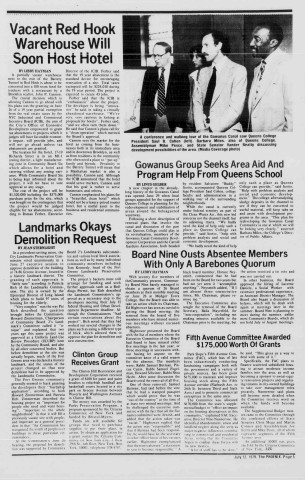
Vacant Red HookWarehouse WillSoon Host HoteiA conference and walking tour of the Gowanus Canal saw Queens CollegePresident Saul B. Cohen (left). Barbara Miles, also of Queens College.Assemblyman Mike Pesce. and State Senator Vander Beatty discussingdevelopment possibilities of the area. (Media Coverage photo)Gowanus Group Seeks Area Aid AndProgram Help From Queens SchoolBY LIBBY HAYMANA partially vacant warehouse next to the exit of the Battery Tunnel in Red Hook is about to be converted into a 100 room hotel for truckers with a restaurant by a \The crucial decision which is allowing Cannon to go ahead with his plans was the granting on June 26 of a 19 year partial exemption from the real estate taxes by the NYC Industrial and Commercial Incentive Board (ICIB), the arm of the City%u2019s Office of Economic Development empowered to grant tax abatements to projects which it judges will have favorable economic impact, will provide jobs, and will not go ahead unless tax abatements are granted.The location for the hotel, 17-19 Richards Street is in an Ml-1 zoning district, a light manufacturing zone in Community Board Six which allows for a hotel and catering without any zoning variance. While Community Board Six is being kept informed about the project, it will not have to vote approval at any stage.The cost of the project will be $1,520,000 including the $375,000 purchase price for the site, which was bought on the contingency that the project would be judged eligible for tax abatements, according to Roman Ferber, ExecutiveDirector of the ICIB. Ferber said that the 19 year abatement is the standard device for encouraging renovation of a site. Total taxes exempted will be $224,010 during the 19 year period. The project is expected to create 43 jobs.Ferber said that the ICIB is %u201c enthusiastic%u201d about the project. The developer is being %u201cinnovative%u201d he said, in taking a virtually abandoned warehouse. %u201c We%u2019re very, very cautious in looking at proposals for hotels%u201d , Ferber said, %u201c and we often turn them down.%u201d He said that Cannon%u2019s plans call for a %u201c clean operation\the Board%u2019s approval.Cannon sees the market for the hotel as coming from the businesses both in its immediate area and in downtown Brooklyn, as well as from residents in the community who often need a place to %u201cput up%u201d family and friends. Proximity to the Battery Tunnel will mean that a Manhattan market is also a possibility. Cannon said. Although the ICIB announced that the hotel would serve truckers, Cannon said that his goal is rather to serve businesses and others.Cannon emphasized his plans for a %u201cbeautiful, clean hotel%u201d which would not be a luxury-priced tourist hotel, but a useful asset to the business and residential communities.BY LINUS GELBERA new chapter in the alreadylong history of the Gowanus Canal was opened June 29 when local groups appealed for the support of Queens College in planning for the redevelopment and stabilization of areas around the beleaguered waterway.Following a short description of renewal plans that involve the canal and discussion of the part that Queens College could play in its revitalization, members of the Gowanus Canal Community Development Corporation and the Carroll Gardens Association, both headedby resident Salvatore %u201c Buddy%u201d Scotto, accompanied Queens College President Saul Cohen, college faculty and administration in a walking tour of the surrounding neighborhoods.While the canal is currently under federal scrutiny as part of the Clean Water Act, this new bid concerns not the channel itself, but its adjoining tracts. %u201c We badly need the kind of help only such a place as Queens College can provide,%u201d said Scotto, %u201c help with problem analysis and social and economic development.%u201c We badly need the kind of helponly such a place as Queens College can provide,%u201d said Scotto. %u201c Help with problem analysis and social and economic development . %u2019 %u2019 The college, after analyzing sludge deposits in the channel to see if they can be converted to useful material, will keep tabs on and assist with development programs in the area. %u201cThis plan for redeveloping the Gowanus Canal Community is one at which we will be looking very closely,%u201d asserted Barbara Miles, the College%u2019s Director of Public Affairs.Landmarks Okays Demolition RequestBY JEAN STERNLIGHTIn a precedent-setting move, the City Landmarks Preservation Commission voted unanimously in a June 27 executive session to approve demolition of the building at 74-86 Greene Avenue, located in a historic landmark district. The granting of such approvals is %u201c fairly rare%u201d according to Patricia Rich of the Landmarks Commis-( sion. The site is owned by the Episcopal Diocese of Long Island which plans to build 97 units of housing for the elderly.%u201c Very complex%u201d was the way Pat Rich described the question brought before the Commission. Howard Zimmerman, Chairperson of Community Board 2%u2019s Landmark%u2019s Committee called it %u201c unique%u201d and explained that two years ago this same project was approved as a Uniform Land-Use Review Procedure (ULURP) item by the Community Board, and also by all other concerned bodies. But before demolition at the site was actually begun, much of the Fort Greene area was declared a historic landmark, and the status of the project changed so that now demolition had to be approved by the Landmarks Commission.The Fort Greene community generally seemed to back granting the developers their %u201c hardship application%u201d , according to both Howard Zimmerman and Patricia Rich. Zimmerman described the housing project as %u201c important for people who need and want housing%u201d , %u201cimportant to the whole neighborhood%u201d in that it will fill a previously vacant site with people, and important as a general precedent in that %u201cthe Commission has recognized the worth of people over buildings in these particular circumstances.At the Commission's June zo hearing, the proposal for demolition was supported by CommunityBoard 2%u2019s Landmarks subcommittee and various local block associations as well as by many individual community members including Tom Kennedy, head of the Fort Greene Landmarks Preservation Committee.The project%u2019s backers must still arrange for funding and seek further approvals such as a Buildings Permit, but Rich described the Landmark Commission%u2019s approval as a necessary step to the developers meeting their July 15 federal Housing and Urban Development Department deadline. Although the Commissioners %u201chad certain reservations about the project%u201d , Rich noted that they had worked out several changes in the plans such as using a different type of brick, which allowed them to approve the plan for demolition and new construction.Clinton GroupReceives GrantThe Clinton Hill Restoration and Development Corporation received a grant of $100 for paint and paint brushes to refurbish handball and basketball courts located in a city park on Greene Avenue between Waverly and Washington Avenues in Clinton Hill.The money was awarded by the Parks Preservation Program, a program sponsored by the Citizens Committee of New York and funded by Bristol-Myers.Funds are still available for groups that need to purchase supplies to put their plans in action. To obtain an application for a grant contact the Citizens Committee tor New York City, 3 West 29th St., 6th floor. New York, New York, 10001, telephone 578-4747.Board Nine Ousts Absentee MembersWith Only A Barebones QuorumBY LIBBY HAYMANWith seventy five members of theCommunity present, Community Board Nine barely managed to obtain a quorum of 26 Board members at their monthly meeting on June 26 at Medger Evers College. But the Board was able to take an action which its Chairman, Ed Hightower has seen as curcial to getting the Board moving: the removal from the board of five members who have missed numerous meetings without excused absences.Hightower presented the Board with the list of members whom the Executive Committee of the Board had found to have missed either five meetings in the last year, or three meetings in succession without having let anyone on the committee know of a valid reason for the absence. The members were: Rabbi Samuel Butman, Pincus Cunin, Rabbi Samuel Fogelman, Howard Scheiner, Rabbi Shea Hecht. After some discussion the Board voted the removal of all five.One of those removed, Samuel Butman, had said before the vote that he had a stamped passport which would prove that he was %u201cout of the country%u201d at the time of at least two missed meetings. And he challenged the executive committee with the fact that all the five names submitted were Jewish, and added that the action taken was %u201c racial.%u201d Hightower replied that the action was \that if Butman had been responsible, he would have let the secretary or other officer know of his excuses earlier. Hightower reemphasized that the removals were \to you to become responsible.%u201d Ablack board member, Horace Neysmilh, commented that he had been on the Board for two years but had not yet seen it %u201c accomplish anything%u201d . Neysmith added, %u201c If I am absent three consectutive times, Mr. Chairman, please remove me.%u201dThe Executive Committee also sought the removal of the Board Secretary, Baila Mayerfeld, for %u201c non-cooperation%u201d , including not making minutes available to the Chairman prior to the meeting, butthe action received a tie vote and was not carried out.In other business, the Board approved the hiring of Laverne Daniels, a Social Worker with extensive professional experience, as Assistant District Manager. The Board also began a discussion of bylaws, which will be dealt with again at meetings later in the summer. Board Nine is planning to meet during the summer, unlike most Community Boards, which do not hold July or August meetings.Fifth Avenue Committee Awarded$175,000 Worth Of GrantsPark Slope%u2019s Fifth Avenue Committee (FAC), which has of late been industriously conducting fundraising campaigns both with the government and a variety of private sources, has been given $175,000 to maintain and improve housing stock along the Fifth Avenue corridor (Flatbush Ave. to 24th St. between Third and Sixth Aves.) and to promote commercial enterprises in the same area.The Committee was allocated $170,000 from the state%u2019s supplemental budget to %u201ceffect an impact on the housing alternatives in this community,%u201d explained FAC Executive Director Nino Nannerone. He identified abandonment, arson and landlord neglect along the strip as major negative influences contributing to commercial and residentialH f ' o n v n n t i n n t a l tVw* f'i %u00bb mihopes to combat these forces with its new monies.%u201c A lot of stuff has to be done,\he said. %u201cThis gives us a way to deal with some of it.%u201dSpecifically, the FAC plans to finance scattered subsidized housing to attract moderate income families into the area, as well as becoming a sponsor to sweat-equity renovation projects and organizing tenants in city-owned buildings to take over management roles privately. Nannerone said plans will become more detailed when the Committee receives word on when the funds will become available.The Supplemental Budget monies came to the Committee through the combined efforts of State Senators Chris Mega and Martin Connor and Assemblyman Joe Ferris and Mike Pesce, all of whom represent segments of the Fifth Avenue area.An additional $5000 was given the FAC by the Citizens Committee of New York.--I.ZGJu ly 12. 1979. The PHOENIX. Pnge 5


